




7 MIN

Nov 11, 2022
Military Auto Transport: PCS Vehicle Shipping Costs, Rules & Process [2026]
Military auto transport is the process of shipping a service member’s personally owned vehicle (POV) to a new duty station during a Permanent Change of Station (PCS) move. The Department of Defense covers the cost of shipping one POV for eligible service members on OCONUS (overseas) PCS orders, arranged through the Defense Personal Property System (DPS) at move.mil.
For CONUS (continental US) PCS moves, vehicle shipping is not a government entitlement – service members arrange and pay for private FMCSA-licensed carriers, with costs ranging from $500 to $1,500 depending on distance and transport type. Peak PCS season runs May through August, when carrier availability drops and rates increase 15–25%. TruckSpot Logistics connects military members with vetted carriers offering flexible scheduling and door-to-door service designed around military timelines.
What Is Military Auto Transport?

Military auto transport refers to the shipping of a service member’s personally owned vehicle (POV) during a PCS move or other military-ordered relocation. It follows the same operational process as standard civilian vehicle transport – the key differences are eligibility for government-covered shipment, the requirement to coordinate with the installation transportation office (ITO), and scheduling constraints tied to the service member’s report date.
Eligible vehicles include cars, trucks, SUVs, and motorcycles. The government covers one POV per eligible PCS order under specific conditions outlined below. All additional vehicles ship at the service member’s expense through private FMCSA-licensed carriers.
How Does Military Car Shipping Work?
Shipping a personal vehicle during a PCS move involves six steps. The process differs depending on whether the move is OCONUS (government-arranged through SDDC) or CONUS (privately arranged by the service member). The steps below apply to private carrier transport for CONUS moves and self-pay OCONUS shipments.
Step 1 – Verify entitlements and set your timeline
Contact your installation transportation office (ITO) as soon as you receive PCS orders. For OCONUS moves, confirm POV shipment eligibility and register in DPS at move.mil before contacting any private carrier. For CONUS moves, confirm your report date and calculate the latest acceptable pickup date – book transport at least 2–3 weeks before the required vehicle arrival date.
Step 2 – Gather required documents
Required documents for military auto transport: copy of PCS orders, vehicle title or registration, current proof of insurance, government-issued ID (military ID or driver’s license), and a completed Power of Attorney if someone else will handle pickup or delivery. For overseas shipments, additional documents include customs declaration forms and country-specific import requirements from your ITO.
Step 3 – Select a carrier and transport typ
Choose an FMCSA-licensed carrier with documented experience in military PCS moves. Verify the carrier’s USDOT number and MC number at safer.fmcsa.dot.gov before signing. Compare at least 3 quotes – rates for the same route can vary $200–$400 between carriers.
| Transport Type | Cost (Cross-Country) | Best For |
| Open transport | $900–$1,500 | Standard vehicles, budget-conscious moves |
| Enclosed transport | $1,500–$2,200 | Luxury, classic, or high-value vehicles |
| Door-to-door | +$100–$200 vs terminal | Tight timelines, no access to terminal |
| Terminal-to-terminal | Base rate | Flexible timeline, lower cost |
Step 4 – Prepare your vehicle
Clean the interior and exterior so pre-existing damage is clearly visible. Remove all personal belongings – items inside the vehicle are not covered by carrier insurance. Photograph all four sides and the undercarriage with a timestamp. Disable aftermarket alarm systems. Reduce fuel to one-quarter tank or less. Record current mileage and document all existing damage on the Bill of Lading at pickup before signing.
Step 5 – Book and confirm in writing
Provide the carrier with your PCS orders copy, pickup address, delivery address, and military contact number. Confirm estimated pickup and delivery windows in writing. Request a certificate of insurance before signing the transport agreement. Verify the carrier’s cancellation and reschedule policy – reputable military-experienced carriers offer free reschedules with 48–72 hours notice.
Step 6 – Track and inspect at delivery
Use the carrier’s tracking system to monitor transit. At delivery, inspect the vehicle against pre-transport photos before signing the Bill of Lading. Note any damage in writing on the delivery receipt before signing – do not sign a clean receipt if damage exists. File a written damage claim within 24–48 hours if needed.
How Much does Military Vehicle Shipping Cost?
Military auto transport costs for CONUS PCS moves depend on distance, transport type, and time of year. The table below shows 2026 cost ranges by route and transport type:
| Route | Distance | Open Transport | Enclosed Transport |
| Regional (under 500 miles) | – | $500–$800 | $900–$1,400 |
| Mid-range (500–1,500 miles) | – | $700–$1,100 | $1,200–$1,800 |
| Cross-country (1,500+ miles) | – | $900–$1,500 | $1,500–$2,200 |
| New York → Phoenix | ~2,421 miles | ~$1,000–$1,300 | ~$1,700–$2,100 |
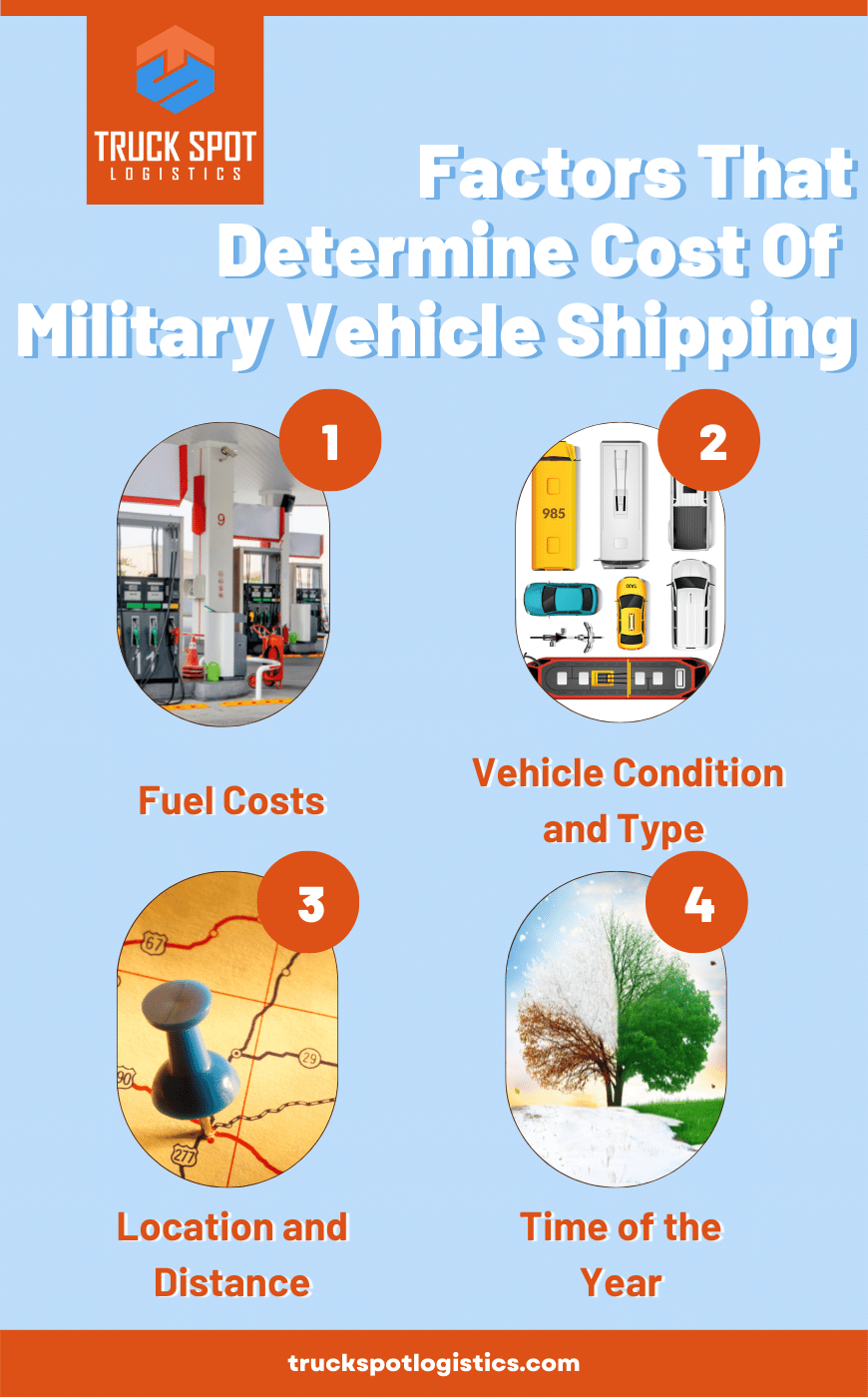
Factors that affect military auto transport cost:
The major thing that affects the cost of military vehicle shipping is the type of transport you choose. Enclosed car transport is expensive compared to open vehicle transport. Similarly, if you have to transport your vehicle overseas, it will cost more than transporting it across Continental US. There are a few other factors as well that affect military car shipping costs.
Who Pays for Military Auto Transportation?

Government coverage of POV shipment depends on order type and destination – not rank or branch. The table below summarizes eligibility:
| Move Type | Government Pays? | Details |
| Overseas PCS (OCONUS) | Yes – 1 POV | Arranged via SDDC through DPS at move.mil |
| CONUS PCS move | No | Service member arranges and pays for private transport |
| Deployment (not PCS) | No | POV transport is not a deployment entitlement |
| Separation / ETS move | Partial in some cases | Confirm with installation transportation office |
| Retirement move (OCONUS) | Yes – 1 POV | Same rules as active duty OCONUS PCS |
Key facts:
What and Where can you Ship?
Licensed carriers can transport any personally owned vehicle during a military PCS move. Vehicle types eligible for military auto transport:
| Vehicle Type | Transport Method | Notes |
| Sedan, coupe, hatchback | Open or enclosed | Standard option for most PCS moves |
| SUV, truck, van | Open or enclosed | Higher cost due to size and weight |
| Motorcycle | Enclosed or crated | Requires specialized tie-down equipment |
| Boat | Flatbed or specialized trailer | Requires separate quote based on dimensions |
| RV / Travel trailer | Flatbed or drive-away | Oversized load rules may apply |
| Inoperable vehicle | Flatbed only | $150–$300 surcharge for winch loading |
Delivery to a military base: Commercial carriers require a temporary base access pass to pick up or deliver vehicles on military installations. Coordinate with your installation’s vehicle registration office to issue a pass for the carrier’s driver at least 5–7 business days before the scheduled pickup date. If base access cannot be arranged, designate an off-base address for vehicle handoff.
Delivery coverage: Carriers in TruckSpot Logistics’ network serve all 48 contiguous US states. For Alaska, Hawaii, and overseas destinations, shipment is coordinated through SDDC or specialized international carriers depending on eligibility.
What Papers Do You Need When Using Military Vehicle Shipping?
Proper documentation is key to a hassle-free PCS vehicle transport experience. Let TruckSpot Logistics guide you through the essentials of military vehicle shipping paperwork.
Here is a list of documents you should keep ready to transport a military vehicle.
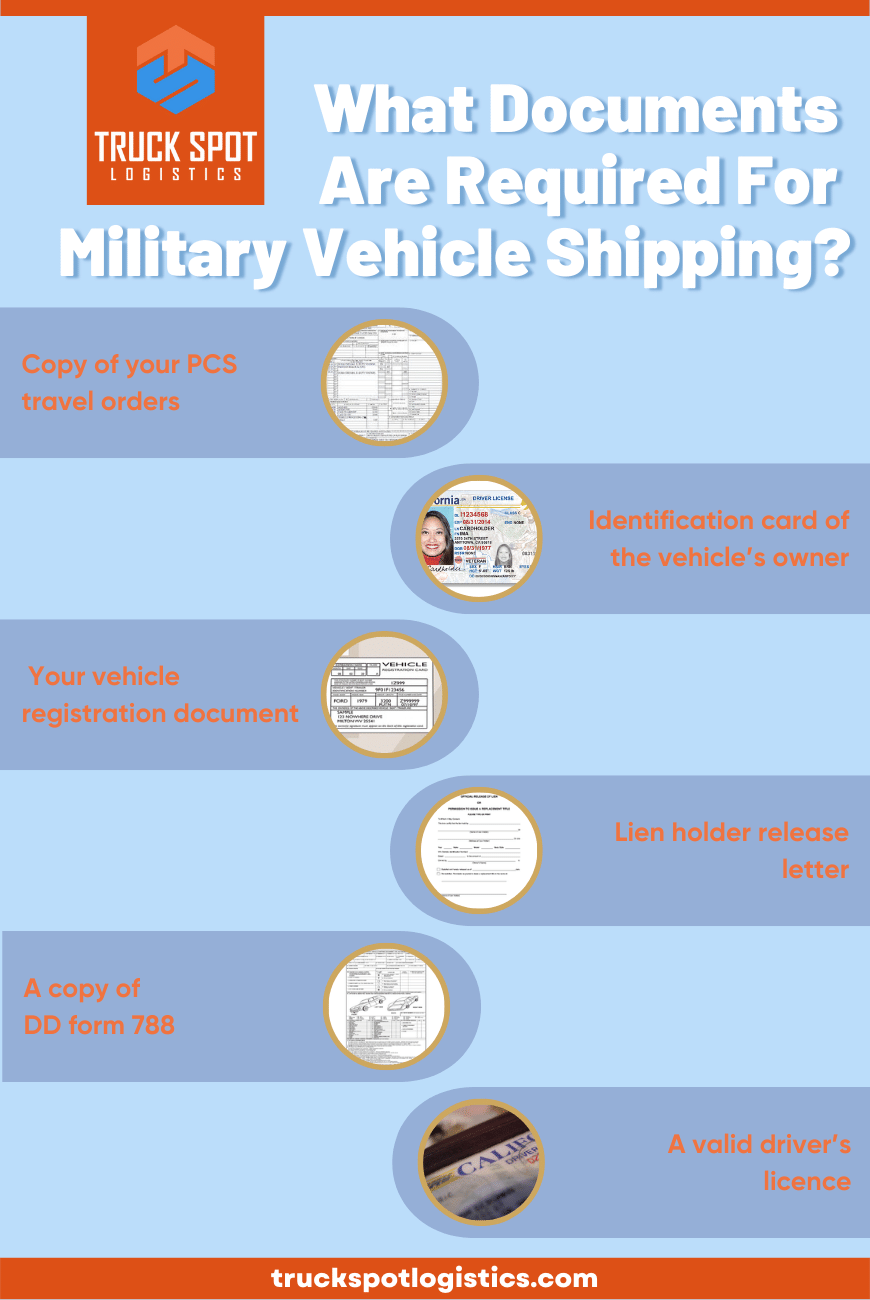
For CONUS private carrier shipment:
| Document | Purpose | Notes |
| Copy of PCS orders | Confirms military status for carrier and potential discounts | Must include reporting date and destination |
| Vehicle title or registration | Proof of ownership | Original or certified copy |
| Current proof of insurance | Required by most carriers before accepting vehicle | Must be valid through estimated delivery date |
| Government-issued ID | Identity verification | Military ID or driver’s license |
| Power of Attorney | Authorizes third party to handle pickup or delivery | Required if service member cannot be present |
For OCONUS government-arranged shipment (through DPS): All documents above, plus: customs declaration forms, host nation-specific vehicle import requirements (provided by ITO at receiving installation), and in some countries, proof of vehicle modifications meeting local safety standards.
Note on DD Form 788: DD Form 788 is a Private Vehicle Storage form used when a service member stores a vehicle on base – it is not a shipping document. Do not confuse it with transport paperwork. If your ITO requests it, it applies to storage only.
Military auto transport for a PCS move is straightforward when approached with the right timeline and documentation. The three most common mistakes are: assuming the government covers CONUS vehicle shipping (it does not), booking a carrier without verifying FMCSA credentials at safer.fmcsa.dot.gov, and failing to document vehicle condition at pickup. For CONUS moves, book 3–4 weeks before your required vehicle arrival date, compare at least 3 carrier quotes, and confirm USDOT and MC numbers before signing.
Truck Spot Logistics works with FMCSA-licensed carriers experienced in military PCS moves, offering flexible scheduling and door-to-door service across the continental US. Get a free quote with your PCS timeline and compare vetted options before your move date.
FAQs
Does the military pay for vehicle shipping during a PCS move?
The US military covers shipment of one POV for service members on OCONUS (overseas) PCS orders, arranged through the Defense Personal Property System at move.mil. For CONUS (continental US) PCS moves, vehicle shipping is not a government entitlement – service members arrange and pay for private transport. Costs range from $500 to $1,500 depending on distance and transport type. Contact your installation transportation office to confirm your specific entitlements before booking any carrier.
How much does military auto transport cost?
Private carrier military auto transport for CONUS PCS moves costs $500–$800 for regional hauls under 500 miles and $900–$1,500 for cross-country routes. Enclosed transport for high-value vehicles costs $1,500–$2,200 cross-country. During peak PCS season (May–August), rates are typically 15–25% higher due to increased demand. Comparing 3–5 carrier quotes 3–4 weeks before your required delivery date reduces cost by 15–30%.
How long will military auto transport take?
Standard open carrier transit for military auto transport takes 1–3 days for regional routes under 500 miles, 3–7 days for mid-range hauls, and 7–14 days for cross-country shipments. Coast-to-coast transport can take up to 14 days during peak PCS season (May–August) due to high carrier demand. Factor in transit time when calculating your latest acceptable pickup date relative to your report date.
Should my car be insured before military auto transport?
Yes – your vehicle should have active insurance before handing it to a carrier. Most FMCSA-licensed carriers require proof of insurance before accepting a vehicle. The carrier’s cargo insurance covers transit damage up to the policy limit, but it does not replace your personal auto policy for pre-existing damage or non-transit events. Verify the carrier’s cargo insurance certificate before signing the transport agreement – minimum $100,000 cargo coverage is standard for licensed carriers.
How far in advance should I book military auto transport?
Book military auto transport as soon as you receive PCS orders – ideally 3–4 weeks before the required vehicle arrival date at your new duty station. During peak PCS season (May–August), book 4–6 weeks in advance as carrier availability drops significantly and rates increase 15–25%. Last-minute bookings under 7 days during peak season cost 20–40% more and may result in vehicle arrival after your report date.
How do I verify a military auto transport carrier is legitimate?
Verify any carrier through the FMCSA SAFER database – confirm an active USDOT number, active MC operating authority, and cargo insurance of at least $100,000. Check carrier reviews on Central Dispatch (centraldispatch.com) and BBB (bbb.org). Request a certificate of insurance before signing the transport agreement. Avoid any carrier that requires full payment upfront before vehicle pickup or cannot provide proof of FMCSA registration on request.
Can I ship personal items inside my vehicle during military auto transport?
Most FMCSA-licensed carriers prohibit personal items inside the vehicle during transport due to DOT weight regulations and insurance exclusions – contents are not covered under the carrier’s cargo policy. Some carriers allow lightweight items up to 100 lbs stored in the trunk, but this must be confirmed in writing before booking. For military moves, household goods are shipped separately through the Defense Personal Property System – do not use your POV as a substitute for HHG shipment, as this violates DPS regulations and may result in claim denial.