


7 MIN

Nov 10, 2026
Towable Trailer Transport: Costs, Types & What to Expect
Towable trailer transport is priced per mile, and the total depends on distance, the trailer’s size and condition, and whether it travels tow-away or loaded on a flatbed. Published per-mile ranges help with planning, but they aren’t a fixed quote: short hauls usually carry a higher per-mile rate, often with a flat minimum, while long cross-country routes cost less per mile. Most roadworthy travel trailers and fifth wheels move tow-away – a licensed driver hitches the unit and hauls it to the destination – while damaged or non-roadworthy trailers ride on a flatbed instead.
Key takeaways
If you already know your pickup and delivery points, get a figure for your exact trailer on our RV & travel trailer shipping page or call +1 (321) 641-0358.
Quick Navigation
How Much Does Towable Trailer Transport Cost?
Price is quoted per mile, but the rate shifts with distance. Long moves spread the carrier’s fixed costs – inspection, dispatch, fuel to reach you – over more miles, so the per-mile rate drops. Short local moves do the opposite: those fixed costs don’t shrink, so carriers set a flat minimum and a higher per-mile rate on shorter trips.
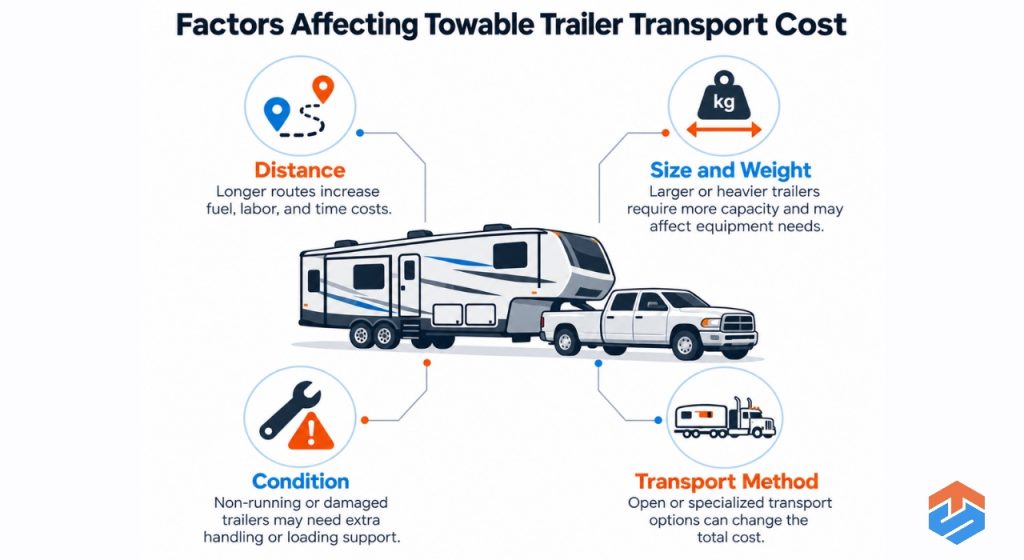
The following routes illustrate how trailer transport costs can vary by distance and location. These figures are examples, not guaranteed quotes or verified current market averages. Actual pricing depends on trailer dimensions, weight, condition, transport method, and carrier availability.
Example Trailer Transport Costs by Route
| Origin | Destination | Example total | Per mile |
| Rocky Mount, VA | Greensboro, NC | ~$300 | $3.50 |
| Newport, OR | Kent, WA | ~$890 | $3.15 |
| Ithaca, NY | Warwick, RI | ~$1,050 | $3.30 |
| Sandpoint, ID | Bozeman, MT | ~$1,200 | $3.25 |
| Cincinnati, OH | Norfolk, VA | ~$2,040 | $3.25 |
| Crisfield, MD | Fernandina Beach, FL | ~$2,380 | $3.00 |
| Denver, CO | International Falls, MN | ~$2,900 | $3.40 |
The Rocky Mount → Greensboro line shows the short-haul effect: under 100 miles still runs a few hundred dollars, because the per-mile rate climbs to cover fixed setup costs. To see the number for your own route, get a trailer shipping quote. For a full breakdown of how carriers build a quote, see our guide on how vehicle shipping costs are calculated.
What Types of Towable Trailers Can Be Transported?
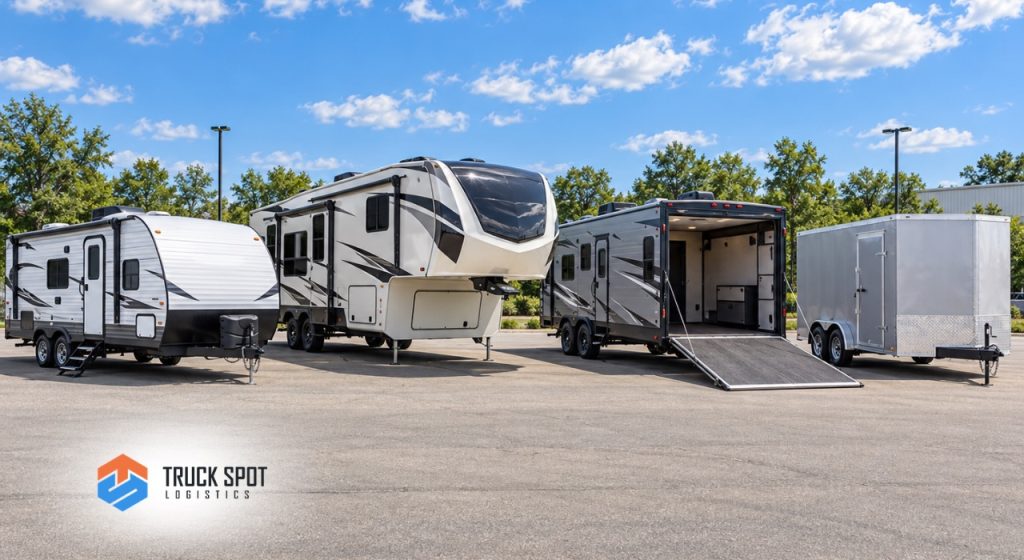
Almost any towable unit can be shipped – the type mainly affects the method and the rate.
Travel Trailers
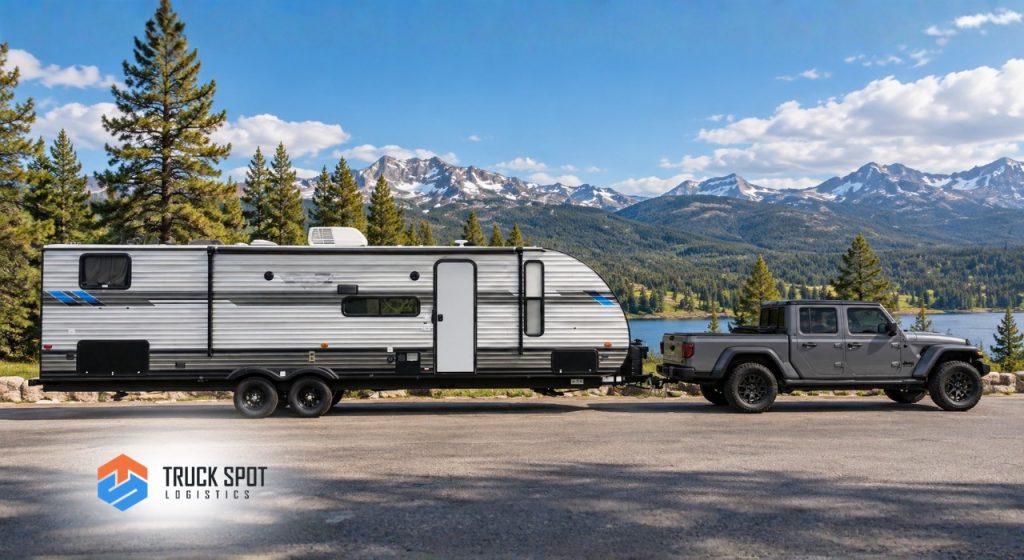
The most common unit we move. Standard bumper-pull travel trailers go tow-away in most cases, as long as the tires, bearings, and lights are sound. Length and height drive most of the cost.
Fifth-Wheel Trailers
Fifth wheels connect through a bed-mounted hitch rather than a bumper coupler, so tow-away needs a driver with the right truck and hitch setup. They’re taller and heavier than most travel trailers, which pushes the per-mile rate toward the upper end. You don’t need to own a pickup to ship one – the carrier brings the tow vehicle.
Toy Haulers
Toy haulers carry extra weight from the garage section and anything left inside. Carriers need the loaded weight, not just the empty curb weight, to quote accurately and confirm the trailer is safe to tow.
Cargo and Utility Trailers
Smaller enclosed cargo and open utility trailers usually follow the same per-mile or flat-rate local structure, and they’re among the cheapest towable units to move. Condition still matters – flat tires or seized bearings change the plan.
Oversized and Specialty Trailers
Anything over typical legal width, height, or weight may need state permits, and sometimes an escort. These moves cost more and take longer to schedule because the route has to clear the dimensions. Permit requirements vary by state; the Federal Highway Administration operates the state oversize/overweight permit directory.
Tow-Away vs. Flatbed Trailer Transport
When Tow-Away Transport Makes Sense
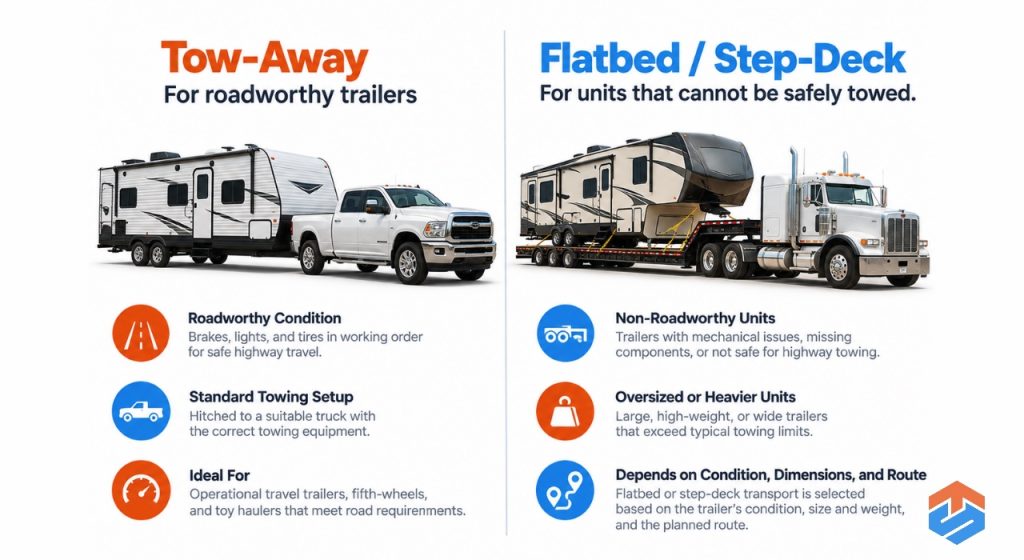
Tow-away is the default for roadworthy trailers. A driver hooks up to your hitch and tows the unit directly, which keeps the cost down. It works when the tires, wheel bearings, brakes, and lights are all in working order, and the trailer sits within legal towing dimensions.
When Flatbed or Step-Deck Transport Is Needed
A trailer goes on a flatbed or step-deck when it can’t be safely towed – bad tires or bearings, no working lights, frame damage, or dimensions that don’t clear for tow-away. Loading it onto the deck also spares the unit road wear and mileage, which matters for newer or higher-value trailers. The trade-off is a higher rate and the need for loading equipment.
How Trailer Size, Weight and Condition Affect the Choice
The decision isn’t only about price. A tall fifth wheel might clear fine for tow-away but exceed height limits on a loaded flatbed. A small utility trailer with a bad axle is simpler to deck than to repair. There’s no single rule that a flatbed is always safer or always required for a non-working trailer – it depends on the specific unit and route.
| Situation | Usual method |
| Roadworthy, legal dimensions | Tow-away |
| Bad tires, bearings, or lights | Flatbed / step-deck |
| Frame or axle damage | Flatbed / step-deck |
| High-value unit, avoid road miles | Flatbed (by preference) |
| Oversized height on a loaded deck | Tow-away |
What Affects the Cost of Trailer Transport?
Any add-on fees should appear on your written estimate. Our breakdown of how auto transport billing works explains what each line means.
How to Prepare a Trailer for Transport
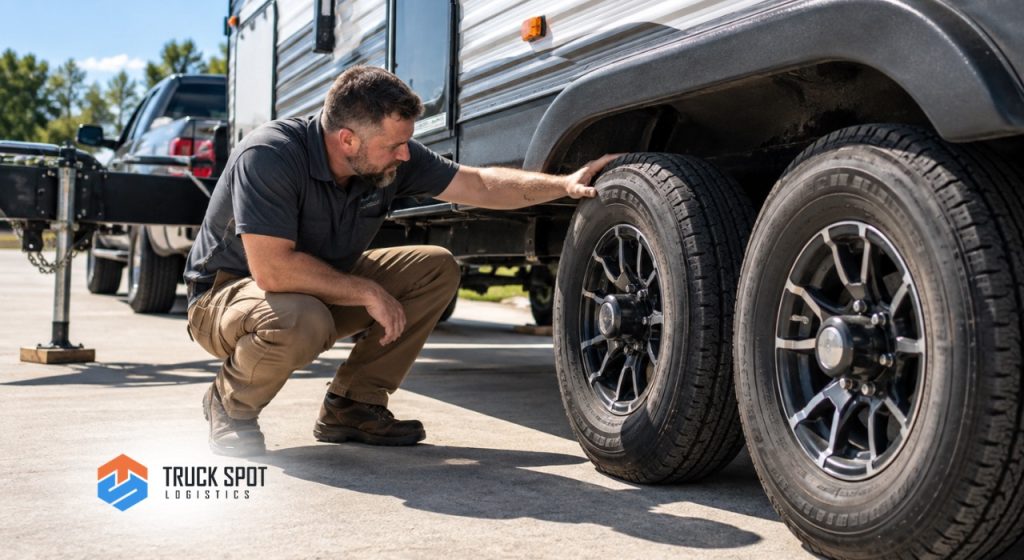
Good prep prevents damage claims and keeps pickup on schedule.
How Does Towable Trailer Shipping Work?
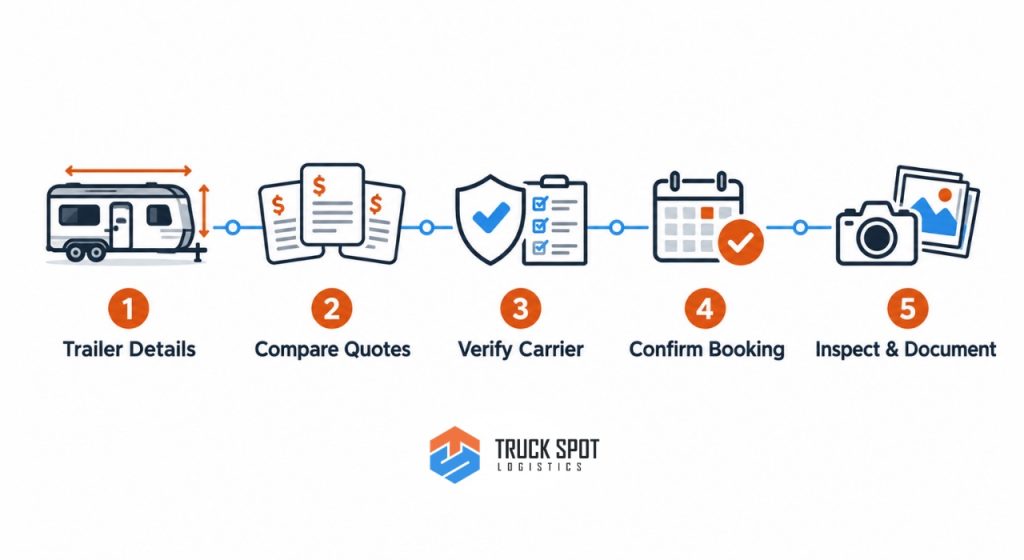
Once your trailer is properly prepared, the next step is arranging safe and reliable transportation. The shipping process involves several stages, from gathering trailer details and comparing quotes to verifying the carrier and coordinating pickup and delivery. Understanding how each step works helps you avoid delays and choose the right transport option.
How Long Does Trailer Transport Take?
Transit time tracks distance, but the full timeline also includes the wait for pickup – which is separate from drive time and depends on when a suitable carrier is routed your way. As a rough guide for the road portion after pickup:
| Mileage | Estimated transit time |
| Up to 500 mi | 2-5 days |
| 500-1,000 mi | 4-7 days |
| 1,000-2,000 mi | 7-10 days |
| 2,000-3,000+ mi | 9-14 days |
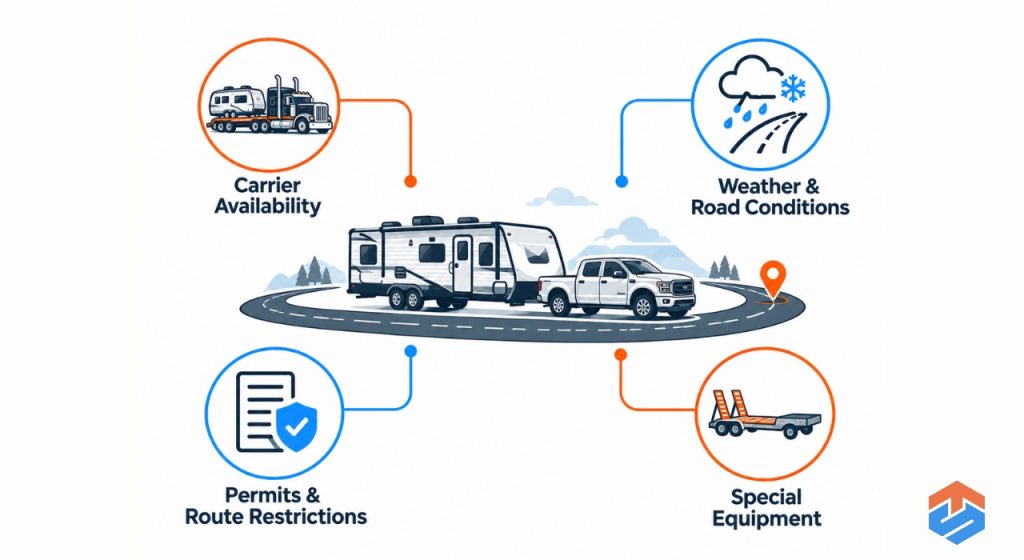
These are planning estimates for the drive itself, not guaranteed delivery dates. Season, weather, permit processing, and equipment availability all stretch or compress the window, and oversized or non-running units can add time for special equipment. A reputable carrier won’t lock a guaranteed delivery date until the trailer is dispatched, so treat any firm date given before booking with caution.
How to Choose a Trailer Transport Company
Choosing the right transport provider is just as important as planning the delivery timeline. A reliable company should have experience with your trailer type, appropriate equipment, and clear insurance and payment terms.
Ready to move your trailer? Get a quote on our vehicle shipping quote page or call +1 (321) 641-0358.
FAQs About Towable Trailer Transport
How much does it cost to transport a travel trailer?
It’s quoted per mile, with short hauls priced at a flat minimum. The exact figure depends on length, weight, condition, route, and method, so treat published ranges as planning estimates until you have a quote for your trailer.
How much does it cost to transport a 32-foot trailer?
There’s no single price – a 32-foot unit is quoted on its weight, height, condition, route, and whether it goes tow-away or flatbed. Give those details for an accurate estimate rather than relying on a flat number.
Is it cheaper to tow a trailer or ship it on a flatbed?
Tow-away is usually cheaper. Flatbed costs more but avoids road wear and mileage, and it’s the safer call for damaged or non-roadworthy units.
Can a fifth-wheel trailer be transported without a pickup truck?
Yes. The carrier supplies the tow vehicle and the correct fifth-wheel hitch, so you don’t need your own truck.
Can a trailer with bad tires or brakes be transported?
Yes, but it typically moves on a flatbed rather than tow-away, since it can’t be safely towed in that condition.
How long does it take to transport a trailer across the country?
The drive itself usually takes several days to two weeks, depending on distance. Add the pickup wait, and plan for a window rather than a fixed date until the carrier dispatches.
Does insurance cover trailer transport?
Carriers must carry insurance, but the type and limits vary by company and authority. Ask for the policy, its limits, and its exclusions in writing before you book.


