





6 MIN

Apr 28, 2023
How To Calculate Vehicle Shipping Cost in 2026: Detailed Guide On How Quotes Are Calculated
Vehicle shipping costs range from $500 to $800 for regional hauls under 500 miles and $900 to $1,500 for cross-country open transport. Enclosed transport costs 40–60% more on any route. The six primary factors that determine the final price are: distance, vehicle size and weight, transport type (open vs enclosed), seasonality, delivery location, and operational status. Prices increase 15–25% during peak season (May–August) and decrease by 10–15% in January–February. A deposit of $0–$200 is due at booking; the remaining balance is paid to the driver at delivery in cash or certified funds.
Factors That Affect Vehicle Shipping Costs
If you’re looking to ship your vehicle, it’s essential to understand the various factors that influence the overall cost. This way, you can budget accordingly and avoid any surprises along the way. In this section, we’ll break down the key elements that determine vehicle shipping costs, so you can make an informed decision when choosing the right auto transport service. Keep in mind that each shipping company may weigh these factors differently, so it’s crucial to gather multiple quotes for comparison. Now, let’s take a closer look at the aspects that can affect your vehicle shipping expenses.

Understanding how each factor affects the final price allows you to estimate costs before requesting a quote.
| Factor | Impact on Price | Example |
| Distance | Primary driver – cost per mile decreases on longer routes | NY → LA (~2,800 mi): ~$1,100–$1,400 open |
| Vehicle size | SUVs/trucks cost 15–25% more than sedans | Same route: sedan $1,100 vs truck $1,300–$1,600 |
| Transport type | Enclosed costs 40–60% more than open | Open $1,100–$1,400 vs enclosed $1,700–$2,200 cross-country |
| Season | Peak (May–Aug): +15–25%; off-peak (Jan–Feb): –10–15% | $1,200 in March → $1,400–$1,500 in July |
| Delivery location | Rural/off-highway adds $100–$300 | Major city vs rural destination on same route |
| Vehicle condition | Inoperable vehicle adds $150–$300 | Non-running car requiring winch loading |
| Door-to-door vs terminal | Door-to-door adds $100–$200 vs terminal | More convenient but higher cost |
By familiarizing yourself with these factors, you’ll be better equipped to estimate your vehicle shipping costs and make a well-informed decision when selecting an auto transport service.
Vehicle Shipping Cost by Route – 2026 Price
The table below shows 2026 open transport cost ranges for a standard sedan by route. Enclosed transport costs 40–60% more on any route. SUVs and trucks add 15–25% to the sedan rate.
| Route | Distance | Open Transport (Sedan) | Open Transport (SUV/Truck) |
| Regional (under 500 miles) | – | $500–$800 | $600–$950 |
| Mid-range (500–1,500 miles) | – | $700–$1,100 | $850–$1,300 |
| Cross-country (1,500+ miles) | – | $900–$1,500 | $1,100–$1,700 |
| New York → Miami | ~1,280 miles | $800–$1,100 | $950–$1,300 |
| New York → Los Angeles | ~2,800 miles | $1,100–$1,400 | $1,300–$1,650 |
| Chicago → Dallas | ~920 miles | $700–$1,000 | $850–$1,200 |
| Los Angeles → Seattle | ~1,140 miles | $750–$1,050 | $900–$1,250 |
| Florida → Texas | ~1,100 miles | $750–$1,050 | $900–$1,250 |
Note on per-mile rates: Rates per mile decrease on longer routes. Short hauls under 200 miles cost $1.50–$3.00 per mile; cross-country routes cost $0.40–$0.60 per mile. This is why shipping is often more economical per mile than driving when time and wear are factored in.
How To Obtain Accurate Quotes
An accurate vehicle shipping quote requires five specific inputs. Providing incorrect or incomplete information is the most common reason quotes change between booking and delivery.
What you need to provide for an accurate quote:
| Input | Why It Matters | Common Mistake |
| Vehicle year, make, model | Determines size class and space on trailer | Estimating dimensions instead of providing exact model |
| Operational status | Inoperable vehicles add $150–$300 | Not disclosing that vehicle doesn’t start or drive |
| Exact pickup and delivery ZIP codes | Determines route, carrier availability, and location surcharges | Using city names instead of ZIP codes |
| Required pickup date range | Affects carrier availability and expedite fees | Booking for a specific date without lead time |
| Transport type | Open vs enclosed affects price by 40–60% | Selecting enclosed when open is sufficient |
How to compare quotes effectively:
Request at least 3 quotes from FMCSA-verified carriers. A legitimate quote itemizes: base transport rate, fuel surcharge (if separate), insurance coverage amount, and any additional service fees. Single-number quotes without breakdown make hidden fees invisible.
Verify each carrier at safer.fmcsa.dot.gov before booking – confirm active USDOT number, active MC authority, and cargo insurance of at least $100,000.
The cheapest quote is not always the best: a $100 lower price from an unverified carrier with inadequate insurance coverage is not a saving – it is a risk. Compare total value: price + verified FMCSA credentials + cargo insurance amount + customer reviews on Central Dispatch or BBB.
Common Misconceptions About Vehicle Shipping Costs
There are several myths about vehicle shipping costs that can cause confusion and lead to unexpected expenses. In this section, we’ll set the record straight on some of the most common misconceptions about vehicle shipping costs.
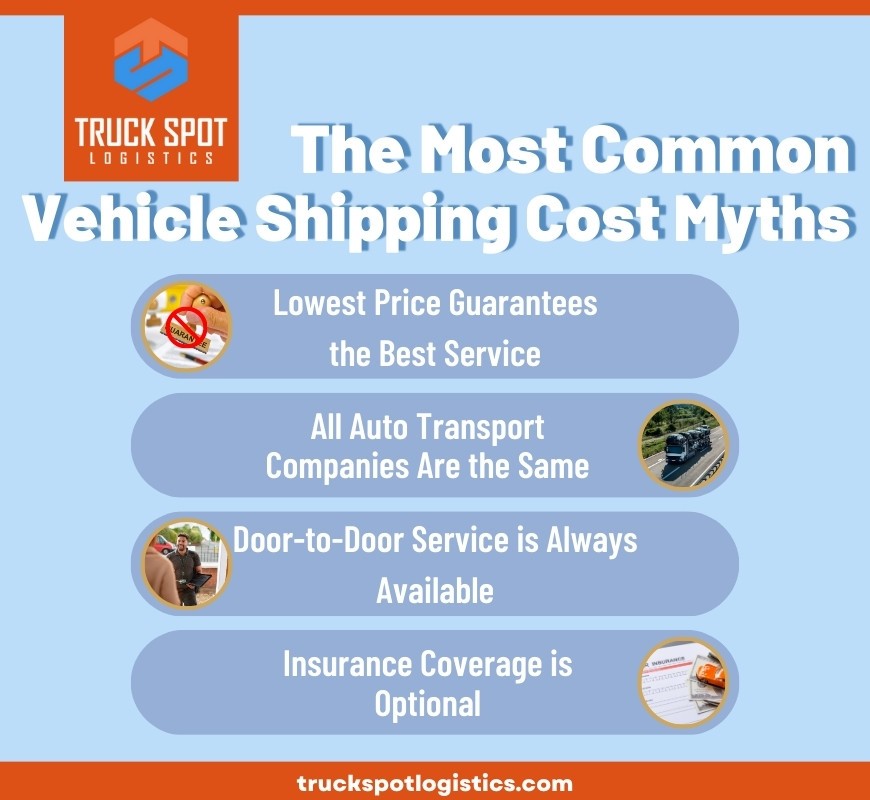
By understanding and dispelling these common misconceptions, you can make better-informed decisions when transporting your vehicle and avoid unexpected expenses or complications.
Vehicle shipping costs are predictable once the six key factors are understood: distance, vehicle size, transport type, season, location, and operational status. The most common budget mistakes are booking during peak season without lead time (+15–25%), selecting enclosed when open is sufficient (+40–60%), and accepting a single-number quote without itemized breakdown. For most standard CONUS moves, open transport booked 2–3 weeks in advance with 3 verified quotes delivers the best combination of price and reliability.
Truck Spot Logistics connects shippers with FMCSA-licensed carriers across all 48 contiguous states. Get a free itemized quote with confirmed insurance coverage and no hidden fees.
FAQs
What is the average cost to ship a car in 2026?
Open transport costs $500–$800 for regional routes under 500 miles and $900–$1,500 for cross-country shipments for a standard sedan. SUVs and trucks cost 15–25% more. Enclosed transport costs 40–60% more than open on any route. Rates are 15–25% higher during peak season (May–August) and 10–15% lower in January–February. Door-to-door service adds $100–$200 versus terminal-to-terminal on the same route.
Is my vehicle insured during transport?
FMCSA-licensed carriers carry minimum cargo insurance of $100,000 per load – not per vehicle. On a standard 8-car open carrier, effective per-vehicle coverage is approximately $12,500. For vehicles valued over $15,000, confirm per-vehicle coverage limits with the carrier before booking. Request a certificate of insurance before signing. Deductibles typically range from $250 to $1,000. Your personal auto insurance policy may provide supplemental coverage during transport – confirm with your insurer.
Can I transport personal belongings in my vehicle?
Most FMCSA-licensed carriers prohibit personal items inside the vehicle during transport. Contents are excluded from the carrier’s cargo insurance – if lost or damaged, there is no coverage. Some carriers allow lightweight items up to 100 lbs in the trunk, but this must be confirmed in writing before pickup. Personal items also add weight that may trigger undisclosed surcharges at pickup. Do not assume enclosed transport changes this rule – the exclusion applies regardless of trailer type.
How do I pay for vehicle shipping?
Standard payment structure: a deposit of $0–$200 is charged to a credit or debit card at booking and deducted from the total at delivery. The remaining balance is paid directly to the driver at delivery in cash or certified funds (money order or cashier’s check). Most carriers do not accept personal checks or credit cards at delivery. Never pay the full transport amount before vehicle pickup – this is a primary red flag for fraudulent carriers.
Do I need to be present for pickup and delivery?
You or an authorized representative must be present at both pickup and delivery to sign the Bill of Lading. At pickup, the BOL documents vehicle condition before loading – your signature confirms the pre-transport condition record. At delivery, you inspect the vehicle against pickup photos before signing. If you cannot be present, provide a signed Power of Attorney authorizing a third party to handle both handoffs. Do not skip the delivery inspection – a signed clean BOL voids damage claims.
Can I cancel my vehicle shipping order?
Most carriers offer full refunds for cancellations made 24–48 hours or more before the scheduled pickup. Cancellations within 24 hours of pickup typically forfeit the deposit ($0–$200). If the carrier has already dispatched a driver, cancellation fees may be higher. Confirm the cancellation policy in writing before booking – reputable carriers state specific refund terms in the transport agreement. Avoid carriers that charge non-refundable full deposits at booking.
How far in advance should I book vehicle shipping?
Book vehicle shipping 2–3 weeks before the required delivery date for standard CONUS moves. During peak season (May–August), book 3–4 weeks in advance – carrier availability drops and rates increase 15–25%. Last-minute bookings under 7 days during peak season cost 20–40% more and limit carrier options. For expedited same-week pickup, budget an additional $150–$300 on top of the base rate. Enclosed transport requires 3–4 weeks advance booking year-round due to lower carrier availability.






[…] condition. If you want to understand how carriers arrive at any transport figure, our breakdown of how to calculate vehicle shipping cost walks through the same logic on a smaller […]