



9 MIN

Oct 10, 2023
Car Shipping vs. Towing: Cost Comparison, Risks & How to Choose [2026]
Car shipping is the process of transporting a vehicle via a licensed carrier – open or enclosed truck – without the owner driving it. Towing means the owner pulls the vehicle behind another vehicle using a tow bar, tow dolly, or flatbed trailer. For a 1,000-mile route, professional car shipping typically costs $600–$1,100, while DIY towing costs $300–$700 in fuel and equipment but adds 2–4 days of driving and wear to both vehicles. The right choice depends on distance, vehicle condition, towing experience, and total cost including time. TruckSpot Logistics connects customers with FMCSA-licensed carriers offering door-to-door car shipping across the continental US.
At first glance, both options might seem pretty straightforward. But when you delve deeper, considering factors like costs, convenience, and safety, the waters get a tad murkier.
We’re here to clear the fog and help you make an informed decision. With a close look at everything from the cost of car towing to the ins-and-outs of car shipping services, we’ll lay out the roadmap for your vehicle’s cross-country journey. Whether you’re relocating, selling, or maybe taking that long-planned road trip, understanding your transport options is crucial. So, grab a cup of joe, and let’s steer through this together.
Defining Long-Distance Car Towing
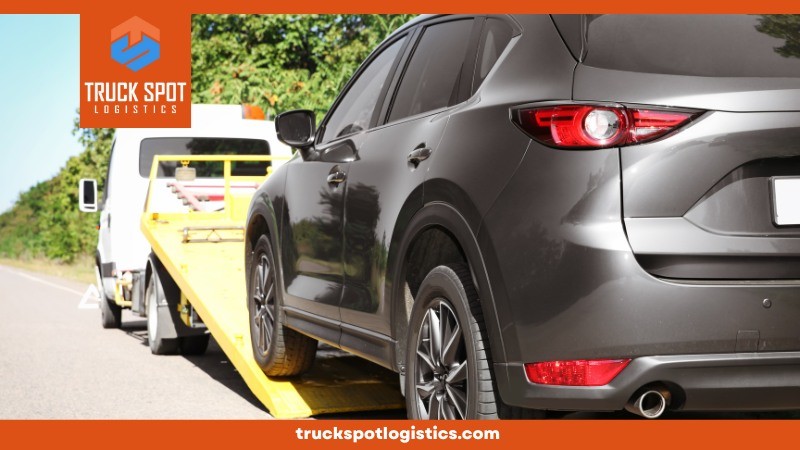
Long-distance car towing is the process of moving a vehicle over 100+ miles using one of three methods: a tow dolly, a flatbed trailer, or a tow bar. Each method has different requirements, costs, and compatibility with vehicle types.
| Towing Method | How It Works | Best For | Avg. Equipment Cost |
| Tow Dolly | Front wheels on dolly, rear wheels roll on road | FWD vehicles under 4,500 lbs | $45–$80/day rental |
| Flatbed Trailer | All 4 wheels off ground on flat platform | Any vehicle, including AWD/4WD | $80–$150/day rental |
| Tow Bar | Vehicle towed on all 4 wheels (flat tow) | Vehicles approved for flat towing by manufacturer | $500–$1,500 purchase |
Not all vehicles can be flat-towed on all four wheels. AWD and 4WD vehicles typically require a flatbed trailer or tow dolly to avoid transmission damage. Always check the manufacturer’s towing guide before choosing a method.
In long-distance car towing, there are various methods that can be employed depending on the customer’s needs and the type of vehicle. For instance, some towing companies offer tow dolly services, where the car’s front wheels are placed on a two-wheeled dolly, and its rear wheels roll on the roadway. This method works well for certain makes and models but may not be suitable for all vehicles based on weight and distribution.
Flatbed towing places all four wheels on a flat platform, eliminating any contact between the towed vehicle’s drivetrain and the road. It is the safest long-distance towing method for all vehicle types, including AWD, 4WD, and non-running vehicles. Flatbed trailer rental costs $80–$150 per day. Fuel consumption of the towing vehicle increases by 20–35% when pulling a loaded flatbed trailer.
Long-distance car towing is a specialized service designed to help individuals transport their vehicles over substantial distances safely and efficiently. Considering the various methods available and the associated costs, it’s essential to research and choose the option that best suits your needs and budget.
Defining Cross-Country Car Shipping
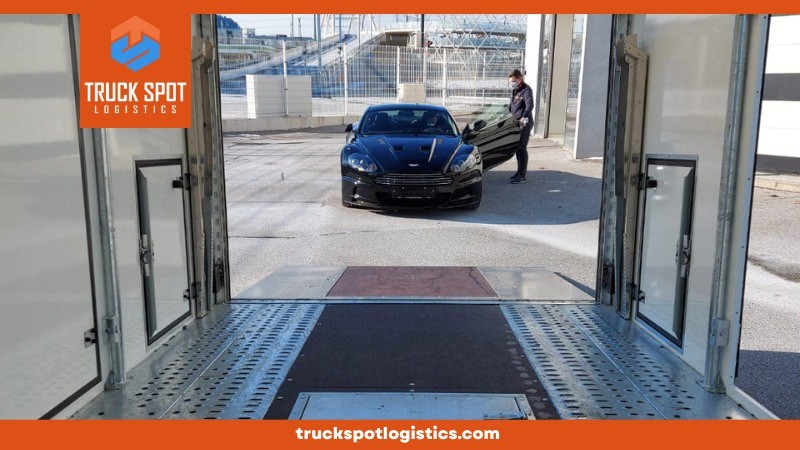
Cross-country car shipping is the process of transporting a vehicle via a licensed carrier without the owner driving it. The vehicle is loaded onto an open or enclosed multi-car trailer and delivered to the destination address. The owner arranges pickup through a transport broker or direct carrier, signs a Bill of Lading at pickup and delivery, and the carrier’s cargo insurance covers the vehicle during transit.
Opting for car shipping services is like gifting your vehicle a stress-free ride. You won’t have to spend days behind the wheel, and with choices like open and enclosed transportation, you can decide the level of protection your car receives during its journey. Open transportation is more common and budget-friendly, but if you have a luxury or classic car, the enclosed option offers an added layer of protection against the elements.
One of the main attractions of car shipping is the time it saves. While your car cruises to its destination, you can fly, catch a train, or even embark on a scenic road trip. Plus, many services even offer door-to-door pick-up and delivery for added convenience.
Of course, there are variables to consider. The cost of car shipping can vary. It’s also essential to check the shipping company’s insurance policy and to inspect your car before and after its voyage.
For those weighing car shipping vs towing or mulling over the cost of car shipping, knowledge is power. And as you navigate these waters, don’t forget TruckSpot Logistics, where you can compare rates from leading car shipping providers, ensuring you cruise towards the best decision.
When considering the best option for your vehicle’s journey, the details matter. Our step-by-step guide ensures you’re fully informed about the entire process.
With this knowledge, you can confidently select a service that offers both value and reliability, tailored to your unique transportation needs.
Comparing Long-Distance Car Towing and Cross-Country Car Shipping
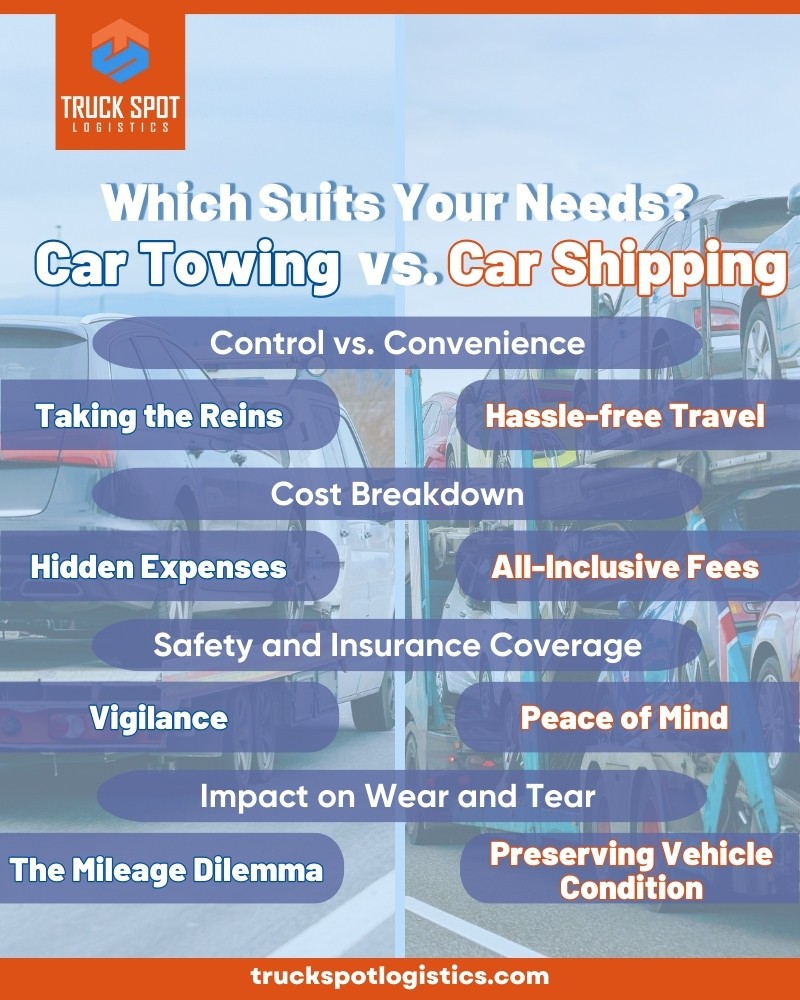
The decision between towing and shipping a car comes down to five measurable factors: total cost, transit time, vehicle wear, safety risk, and convenience. The table below provides a direct comparison for a 1,000-mile route as the benchmark.
| Factor | Car Shipping (Professional) | DIY Towing |
| Total cost (1,000 miles) | $600–$1,100 | $300–$700 (fuel + equipment) |
| Total cost (cross-country, 2,500 miles) | $900–$1,500 | $600–$1,200+ (fuel, lodging, meals) |
| Transit time | 7–14 days (owner travels separately) | 3–5 days of continuous driving |
| Miles added to towed vehicle | 0 | Full route mileage |
| Miles added to tow vehicle | 0 | Full route mileage |
| Fuel consumption increase | N/A | 20–35% higher when towing |
| Insurance coverage | Carrier’s cargo policy ($100,000+) | Personal auto policy (verify towing coverage) |
| Towing equipment required | None | Hitch, tow dolly or flatbed trailer |
| Suitable for AWD/4WD vehicles | Yes | Only with flatbed trailer |
| Suitable for non-running vehicles | Yes | Only with flatbed trailer |
| Driver fatigue risk | None | High on routes over 500 miles |
When each method makes sense:
Choose professional car shipping when:
Choose DIY towing when:
Cost-Benefit Analysis: Towing vs Shipping
The true cost of DIY towing is frequently underestimated. Beyond fuel, owners must account for rental equipment, lodging, meals, and the long-term cost of added mileage and mechanical wear on the tow vehicle.
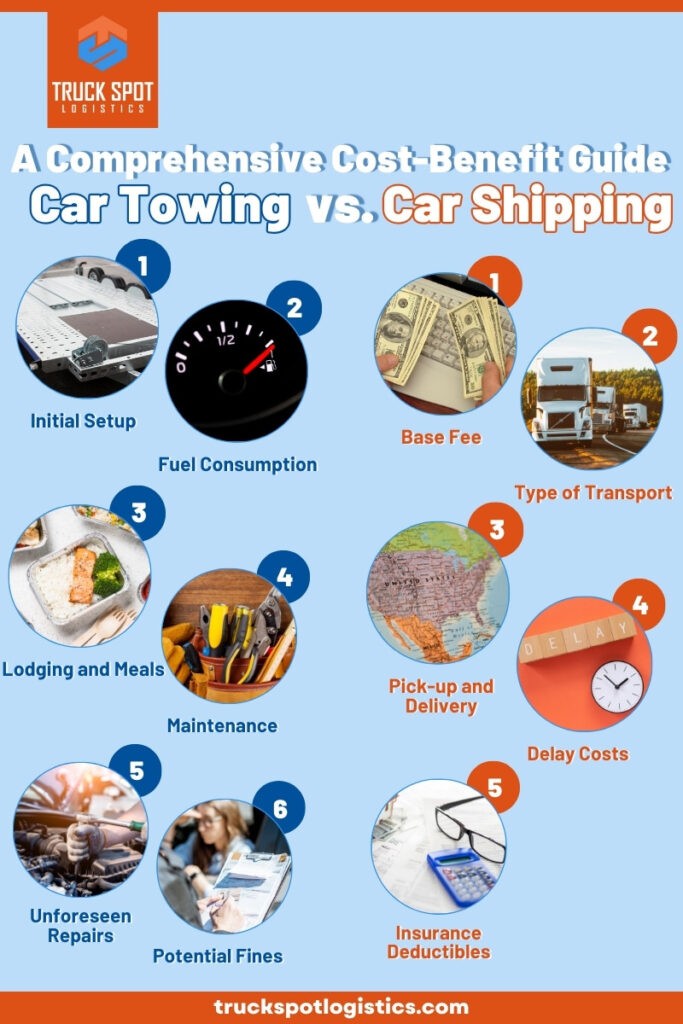
| Cost Item | Car Shipping | DIY Towing (1,000 miles) | DIY Towing (2,500 miles) |
| Base service / fuel cost | $600–$1,100 | $150–$250 | $380–$620 |
| Equipment rental (tow dolly/flatbed) | $0 | $90–$150 (2 days) | $180–$300 (4 days) |
| Overnight lodging | $0 | $0–$120 (1 night) | $240–$480 (3–4 nights) |
| Meals on the road | $0 | $40–$80 | $100–$200 |
| Tow vehicle wear & depreciation | $0 | $100–$200 est. | $250–$500 est. |
| Towed vehicle mileage cost | $0 | $150–$200 est. | $375–$500 est. |
| Estimated total | $600–$1,100 | $530–$1,000 | $1,525–$2,600 |
Key insight: For routes under 500 miles, DIY towing may cost less than professional shipping. For routes over 1,000 miles, total costs converge or favor professional shipping once vehicle wear, lodging, and time are factored in.
Hidden Costs of DIY Towing
The three most common unexpected costs in DIY towing are: roadside mechanical failures (average repair cost: $300–$1,500 when far from home), traffic fines for improper towing setup ($100–$500 depending on state), and insurance gaps — many personal auto policies exclude towing-related damage to the towed vehicle. Verify your policy covers towing before departure.
Hidden Costs of Car Shipping
The two most common unexpected costs in professional car shipping are: insurance deductibles on damage claims (typically $250–$500 per incident) and rental car costs if shipping is delayed beyond the agreed delivery window. To avoid delays, book at least 2–3 weeks in advance and confirm the carrier’s estimated delivery window in writing before signing the transport agreement.
How to Choose: Car Shipping vs. Towing – Decision Checklist
Use the following thresholds to determine which method is right for your situation:
| Your Situation | Recommended Method |
| Route over 1,000 miles | Car shipping |
| AWD or 4WD vehicle | Car shipping (or flatbed tow only) |
| Non-running vehicle | Car shipping or flatbed tow |
| No compatible tow vehicle | Car shipping |
| Luxury or high-value vehicle | Enclosed car shipping |
| Route under 300 miles, FWD vehicle | DIY towing (tow dolly) |
| Flexible timeline, budget is priority | DIY towing (flatbed trailer) |
| Fixed delivery deadline under 5 days | Hot shot car transport |
Conclusion
Car shipping and DIY towing both move a vehicle from point A to point B – but they serve different needs. Towing costs less on short routes under 500 miles but adds full mileage to both vehicles, requires proper equipment, and demands driving experience. Professional shipping costs more upfront but preserves the vehicle’s mileage, includes cargo insurance, and frees the owner from days behind the wheel.
For routes over 1,000 miles, AWD or 4WD vehicles, non-running cars, or any situation where time has a dollar value, professional shipping is the more cost-effective choice when total expenses are calculated. TruckSpot Logistics connects you with FMCSA-licensed carriers across the continental US – get a free quote and compare options before making a decision.
FAQs
Is it cheaper to ship or tow a car long distance?
For routes under 500 miles, DIY towing is typically cheaper: $300–$700 in fuel and equipment vs. $400–$800 for professional shipping. For routes over 1,000 miles, total costs converge when lodging, meals, and vehicle wear are factored in. A 2,500-mile DIY tow costs $1,500–$2,600 in total vs. $900–$1,500 for professional car shipping. Distance is the primary factor in which option provides better value.
What is the difference between car shipping and towing?
Car shipping uses a licensed carrier to transport a vehicle on a multi-car trailer without the owner driving. Towing means the owner pulls the vehicle behind another vehicle using a tow dolly, flatbed trailer, or tow bar. Shipping adds zero miles to the vehicle; towing adds full route mileage. Shipping requires no special equipment from the owner; towing requires a rated hitch and compatible tow vehicle.
What towing methods are available for long-distance transport?
Three towing methods are used for long-distance vehicle transport. A tow dolly lifts only the front wheels and is compatible with FWD vehicles under 4,500 lbs ($45–$80/day rental). A flatbed trailer carries all four wheels off the ground and works for any vehicle type including AWD/4WD ($80–$150/day). A tow bar flat-tows the vehicle on all four wheels and is only suitable for manufacturer-approved vehicles.
How do I ensure the car shipping company I choose is reputable?
Verify any car shipping carrier through three official sources: FMCSA’s SAFER database (safer.fmcsa.dot.gov) to confirm active MC number and insurance, the Better Business Bureau (bbb.org) for complaint history, and Central Dispatch for carrier reviews from brokers. A legitimate carrier must hold active cargo insurance of at least $100,000 and provide a certificate of insurance before pickup. Avoid carriers that request full payment upfront before vehicle pickup.
What’s faster – car shipping or towing?
DIY towing is faster in calendar days if you drive continuously: a 2,500-mile route takes 3–5 days of driving vs. 7–14 days for standard open carrier shipping. However, shipping allows the owner to fly or travel separately, freeing those same days for other activities. For time-sensitive deliveries under 5 days, hot shot transport ($800–$2,000) is faster than both standard shipping and DIY towing over long distances.
Can I keep personal items in the car during shipping?
Most licensed car shipping carriers prohibit personal items due to DOT weight regulations and insurance exclusions – contents inside the vehicle are not covered under the carrier’s cargo insurance. Some carriers allow lightweight items up to 100 lbs stored in the trunk, but this varies by company. Confirm the policy in writing before loading. During DIY towing, personal items can be kept inside but add weight, which increases fuel consumption and affects vehicle handling.
How far in advance should I book car shipping?
Book car shipping 2–3 weeks before the required pickup date for standard routes. During peak season (May–September), book 4–6 weeks in advance to secure competitive rates and carrier availability. Last-minute bookings under 7 days typically cost 20–35% more due to limited carrier capacity. For cross-country moves with a fixed delivery deadline, confirm the carrier’s estimated delivery window in writing before signing the transport agreement.
Are there vehicles that cannot be towed or shipped?
Most vehicles can be shipped without restrictions. Towing has more limitations: AWD and 4WD vehicles cannot be flat-towed and require a flatbed trailer to avoid drivetrain damage. Vehicles exceeding standard carrier height (over 7 ft) or width (over 7 ft) require a flatbed or specialized trailer for shipping. Non-running vehicles can be shipped but require a winch or forklift for loading, adding $100–$250 to the base shipping cost. Always disclose vehicle condition at the time of booking.
What happens if my car is damaged during shipping?
If damage occurs during professional car shipping, document it immediately at delivery with timestamped photos and note all damage on the Bill of Lading before signing. File a written claim with the carrier within 24–48 hours – most carriers require prompt written notice. The carrier’s cargo insurance covers transit damage up to the policy limit, typically $100,000. Insurance deductibles range from $250–$500. Pre-existing damage documented at pickup is excluded from claims.