


10 MIN

Jun 22, 2026
How to Ship an SUV: What’s Different From Shipping a Regular Car
You just requested a quote for auto transport, and the number came back $200 to $400 higher than what a standard sedan costs on the exact same route. This is the moment most people wonder if they are being overcharged.
This price difference is not a mistake, nor is it a broker markup. When it comes to how to ship an SUV, pricing is entirely driven by hard logistics. Every extra inch of height and every extra pound of curb weight on your Ford Explorer or Chevrolet Suburban directly impacts how a carrier loads their trailer. In the auto transport industry, space and weight equal money.
Here is exactly what happens when your SUV is assigned to a transport trailer, why the pricing tiers work the way they do, and how to ensure you get an accurate quote without any surprise fees at pickup.
Before we dive in – here’s what matters most:
Quick links to navigate this article:
Why SUVs Cost More to Ship – The Real Mechanics
Auto transport carriers operate on tight margins. To stay profitable, a driver needs to maximize the capacity of their open hauler. Shipping an SUV disrupts that standard capacity formula in three specific ways.
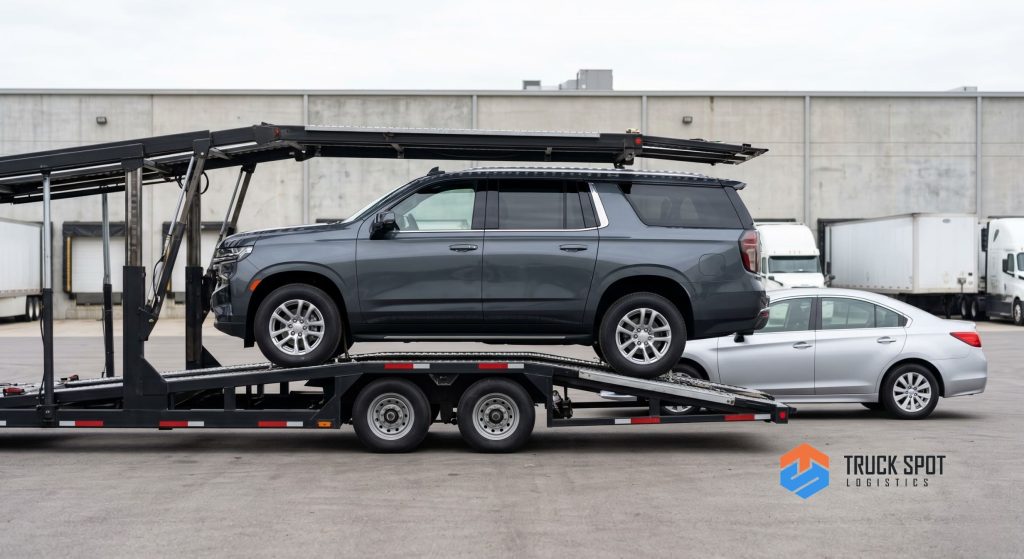
1. Trailer Space: The 1.5 Vehicle Rule
An SUV simply takes up more physical real estate on a trailer. A standard two-tier open transport trailer is designed to comfortably haul 9 to 10 standard-sized sedans. A full-size SUV or large pickup truck often occupies the equivalent of 1.5 standard vehicle slots.
If a carrier loads two full-size SUVs, their total trailer capacity can drop from 9 vehicles down to 7 or 8. To make the same profit on that route, the carrier reallocates the lost revenue from those missing slots to the larger vehicles. You are paying for the extra space your vehicle commands.
2. Weight Limits and Fuel Consumption
The average mid-size SUV weighs between 1,000 and 1,500 pounds more than a compact car. Carriers are strictly bound by FMCSA federal weight regulations, which dictate the maximum gross vehicle weight a truck can legally carry on interstate highways.
If a carrier loads too many heavy SUVs, they hit their maximum legal weight limit before all trailer slots are filled, forcing them to run partially empty. Hauling a heavier load also significantly decreases the semi-truck’s fuel efficiency. With diesel fuel being one of the largest carrier overhead costs – tracked closely by the U.S. Energy Information Administration – carriers calculate that extra fuel burn directly into the SUV shipping rate.
3. Height Restrictions and the Double-Deck Problem
This is the logistical factor most people are unaware of. Standard open haulers have two decks. The upper deck has strict height clearance requirements to prevent vehicles from striking overpasses or bridges.
The average SUV is about 6 feet tall, with many full-size models even taller. Because of this, carriers often cannot safely load an SUV on the top deck. They are forced to reserve lower deck or single-tier sections for taller vehicles. Because lower-deck spots are limited and in high demand, securing one commands a premium rate.
For a full breakdown of how vehicle size, route, and trailer type affect pricing across all distances, see our car shipping cost guide.
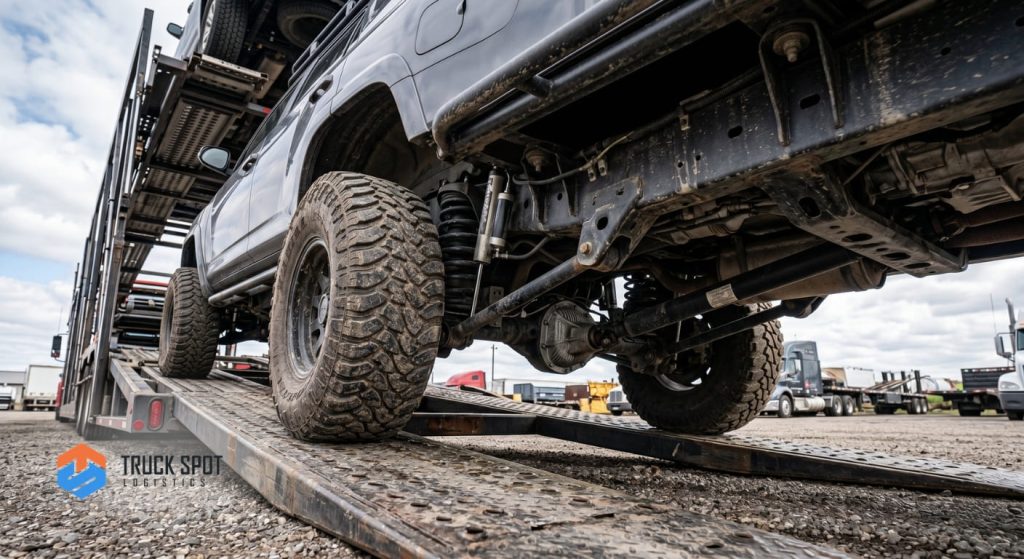
Not All SUVs Are Priced the Same – The 4 Categories
One of the biggest mistakes you can make when requesting a quote is simply stating you want to “ship an SUV.” In the transport world, a Honda CR-V and a Chevy Suburban belong to two completely different pricing categories.
If a broker quotes a flat “SUV rate” without asking for your specific make and model, they are giving you an inaccurate estimate. Here is how carriers actually categorize and price SUVs compared to a standard sedan:
| Category | Vehicle Examples | Average Markup vs. Sedan | Notes |
| Compact crossover | Honda CR-V, Toyota RAV4, Mazda CX-5 | +$50–$100 | Minimal footprint difference; behaves logistically almost like a sedan |
| Mid-size SUV | Ford Explorer, Jeep Grand Cherokee, Toyota 4Runner | +$100–$200 | Standard SUV surcharge based on average weight and height |
| Full-size SUV | Chevy Suburban, Ford Expedition, GMC Yukon XL | +$200–$400 | Significant price jump due to weight and maximum trailer space footprint |
| Lifted / Modified SUV | Any SUV with lift kit, oversized tires, or roof rack | +$300–$600+ | May exceed standard trailer dimensions, requiring specialized transport |
Before booking, review the most common mistakes people make when shipping a vehicle – several of them are specific to larger vehicles.
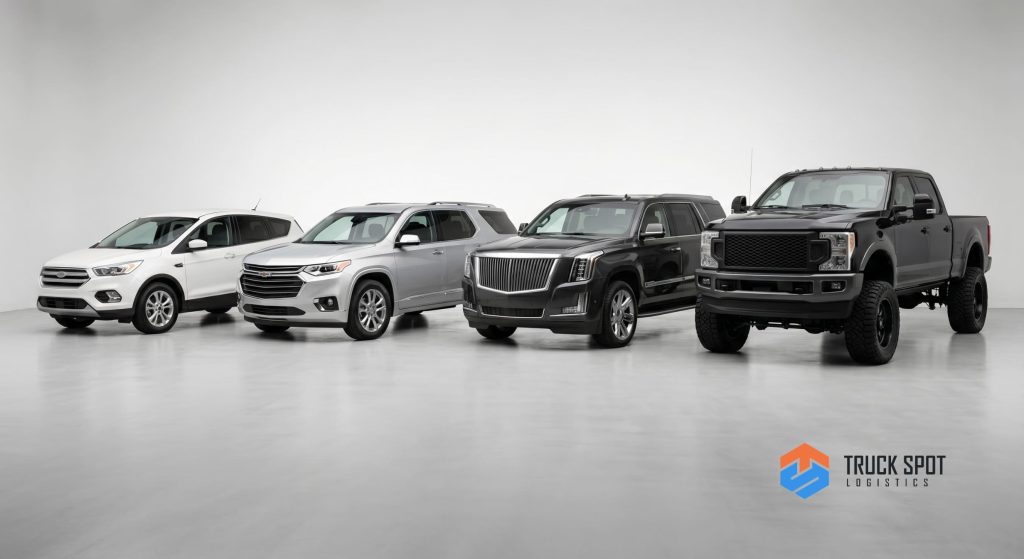
The Lifted and Modified SUV Problem
If you drive a lifted SUV or a truck with aftermarket modifications, you are not just dealing with a more expensive shipment – you are dealing with a specialized logistical situation that requires explicit upfront communication.
Modifications fundamentally change your vehicle’s factory specifications, which carriers rely on to plan their loads:
Height clearance. A lift kit of 3 inches or more can push an SUV past the clearance limit of a standard open hauler’s upper deck structure.
Securing the vehicle. Oversized tires (typically 33 inches or larger) often do not fit standard trailer wheel troughs and require non-standard wheel straps to secure safely.
Overall dimensions. A permanent roof rack, overlanding cargo setup, or heavy-duty aftermarket steel bumper extends the vehicle’s height and length beyond standard trailer slot dimensions.
The worst-case scenario. If you do not disclose these modifications to your broker, the carrier driver will arrive at pickup, realize the vehicle physically does not fit on their trailer, and refuse the load. You will be left paying a rescheduling or cancellation fee and lose days or weeks while searching for a specialized carrier.
The rule: If your vehicle deviates in any way from its factory stock condition, tell your broker before you finalize the quote. Disclosing a lift kit or a roof rack does not inflate your price – it ensures the broker dispatches the correct trailer type so your pickup happens on schedule.
If your SUV requires specialized handling, read our enclosed auto transport guide for details on the available carrier types.
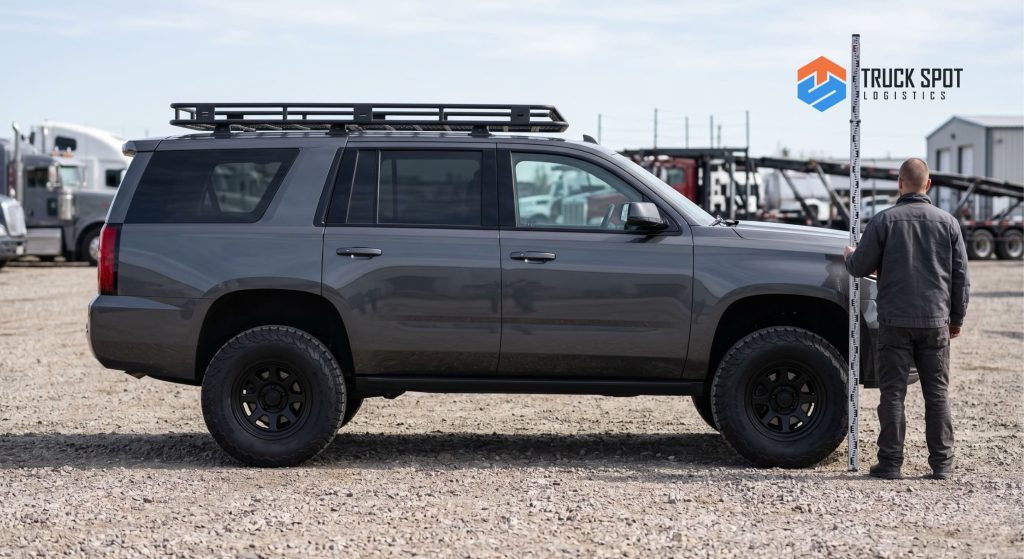
How to Get an Accurate Quote for Your SUV
Requesting a quote for a larger vehicle requires precision. If you simply input “Ford Explorer” without specifying the trim level or aftermarket additions, the carrier will arrive expecting factory dimensions. If your vehicle deviates from those dimensions, the driver has the right to refuse the load or charge an immediate oversize fee on the spot.
Standard information required:
More information required for SUVs:
When speaking with your broker, answer these questions explicitly:
If you bought the vehicle used and are unsure of the exact factory specifications, provide your broker with the VIN number. A competent broker can cross-reference the NHTSA vehicle specifications database to pull exact curb weight and factory dimensions, ensuring the carrier knows precisely what they are picking up.
Ready to get an exact quote for your SUV? Use our shipping calculator and provide your vehicle details for a guaranteed, accurate estimate.
Open vs. Enclosed Transport – Which Makes More Sense for an SUV?
Because you are already paying a premium for the size and weight of your SUV, carefully consider whether enclosed transport is actually necessary before adding 30% to 50% to your bill.
For a standard, daily-driven SUV without major modifications, open transport is the most cost-effective option. The vast majority of SUVs on the road today are shipped via open carriers. They are exposed to the same weather, rain, and road dust they would encounter if you drove the vehicle yourself.
Only pay the enclosed premium if your SUV falls into one of these categories:
| SUV Type | Recommended Transport | Estimated Cost vs. Sedan |
| Compact crossover (CR-V, RAV4) | Open | +$50–$100 |
| Mid-size SUV (Explorer, 4Runner) | Open | +$100–$200 |
| Full-size SUV (Suburban, Expedition) | Open | +$200–$400 |
| Luxury SUV (Range Rover, Escalade) | Enclosed | +30–50% on top of SUV rate |
| Lifted SUV (3″+ lift kit) | Enclosed or flatbed | Varies based on height |
For a complete side-by-side breakdown of how open and enclosed carriers differ in protection, pricing, and availability, see our open auto transport guide.
SUV Shipping Cost Examples by Route
Here is a direct comparison of estimated shipping costs for a standard sedan (Honda Accord), a mid-size SUV (Ford Explorer), and a full-size SUV (Chevrolet Suburban) via open transport across the most common interstate routes:
| Route | Sedan (Open) | Mid-Size SUV (Open) | Full-Size SUV (Open) |
| New York → Florida (1,300 mi) | $800–$1,000 | $950–$1,200 | $1,100–$1,400 |
| Texas → California (1,500 mi) | $900–$1,100 | $1,100–$1,400 | $1,300–$1,600 |
| Chicago → Los Angeles (2,000 mi) | $1,000–$1,300 | $1,200–$1,500 | $1,400–$1,800 |
| Local / Regional (under 500 mi) | $400–$600 | $500–$750 | $600–$900 |
These are estimates for standard open transport with a factory-spec vehicle. Enclosed transport adds 30–50%. Lifted or modified SUVs may require a custom quote.
Want exact pricing for your route and vehicle? Get your custom SUV shipping quote – takes under 60 seconds.
How to Prepare Your SUV for Shipping
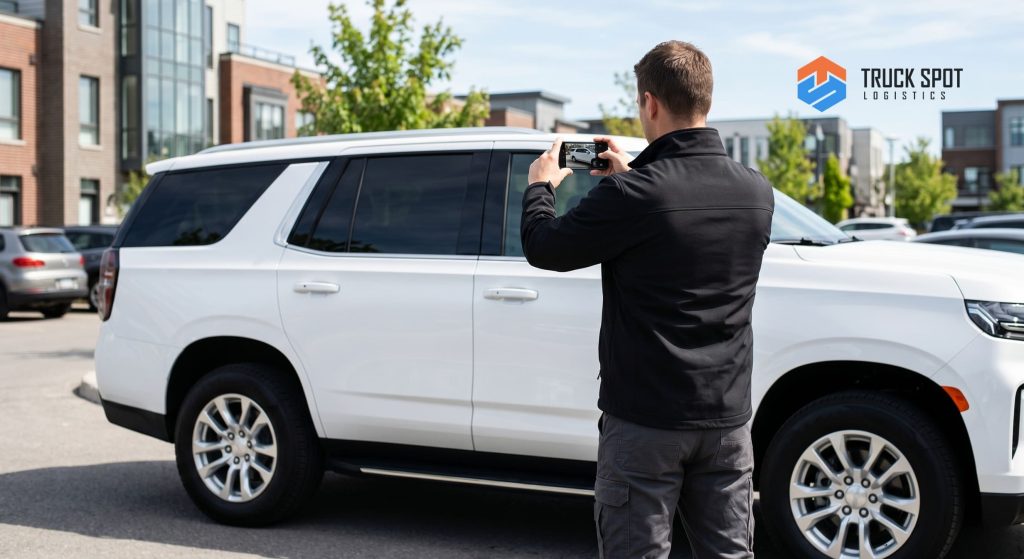
Preparing an SUV for transport involves steps that go beyond the standard car shipping checklist. Because SUVs push the physical limits of trailer capacity, minimizing your vehicle’s footprint makes the loading process safer and prevents last-minute fees.
Remove roof racks and cargo carriers. If your roof rack or crossbars are removable, take them off and store them inside the vehicle. Leaving them on increases the vehicle’s height, which may force the driver to use a lower deck slot – a premium position that can increase your quote. If they cannot be removed, inform your broker immediately during the quoting process.
Check running boards and side steps. Wide aftermarket running boards can occasionally exceed standard DOT vehicle dimension regulations for trailer width. Ensure they do not protrude excessively beyond the vehicle’s body line, or be prepared to remove them if the carrier requests it.
Fold in the mirrors. Space is extremely tight on an open auto hauler. Folding your side mirrors reduces the vehicle’s overall width and gives the driver more clearance when maneuvering your SUV onto the loading ramps.
Standard preparation checklist:
Conclusion
Shipping an SUV is not complicated, but it rewards people who provide accurate information upfront. The customers who avoid surprise fees, pickup refusals, and rescheduling delays are the ones who tell their broker exactly what they are shipping – trim level, lift height, roof rack, tire size – before the quote is finalized.
For most daily-driven SUVs, the process is simple: open transport, accurate vehicle description, a 3-to-5-day pickup window, and a carrier verified through the FMCSA SAFER database. The SUV surcharge is real, but it is a reflection of actual carrier logistics – not an arbitrary markup.
The only genuinely avoidable costs are those arising from surprises at pickup. Disclose your modifications, provide your trim level, and get a quote based on your vehicle’s real dimensions. Everything else follows from there.
Get your guaranteed SUV shipping quote from Truck Spot Logistics – or explore our full range of car shipping services to find the right option for your vehicle.
FAQ About How to Ship an SUV
How much more does it cost to ship an SUV vs a regular car?
Shipping a compact crossover like a Honda CR-V typically costs $50–$100 more than a sedan on the same route. A full-size SUV like a Chevrolet Suburban or Ford Expedition can cost $200–$400 more. The difference comes from the larger trailer space occupied, additional vehicle weight, and height restrictions on standard two-tier open haulers.
Can a lifted SUV be shipped on a standard open carrier?
It depends on the lift height. A mild 2-inch lift usually fits on a standard open hauler. A lift of 3 inches or more may exceed the clearance of the upper trailer deck, requiring placement on a specialized single-tier or enclosed carrier. Always disclose your lift kit height when requesting a quote to avoid pickup refusal on the day of transport.
Do roof racks or bike racks affect the shipping price?
Yes. A roof rack or cargo carrier increases the vehicle’s overall height, which directly affects the vehicle’s placement on the trailer. The carrier may be forced to use a lower deck or a single-tier hauler to accommodate the added height. If the rack is removable, taking it off before shipping will often result in a lower quote.
Is open transport safe enough for an SUV?
Yes. The majority of SUVs – including mid-size and full-size models – are routinely shipped via open transport safely. Consider enclosed transport only for luxury SUVs valued over $60,000, brand-new vehicles, or those with custom paint or wraps that require additional protection from road debris and weather.
What information should I provide to get an accurate SUV shipping quote?
Provide the exact year, make, model, and trim level. Also disclose any modifications: lift kits and their specific height, roof racks, oversized tires (33 inches or larger), aftermarket bumpers, or extended wheelbases. Carriers’ prices are based on exact dimensions and weight. Inaccurate vehicle descriptions at the quote stage almost always result in price adjustments at pickup.
Why did my SUV quote change when I mentioned a lift kit?
A lift kit changes the vehicle’s effective height and may require a different carrier type or trailer position. Standard quotes assume factory specifications. When you disclose aftermarket modifications, the broker updates the quote to reflect the actual carrier requirements. This is not a surcharge – it is an accurate quote based on your vehicle’s real dimensions.