


MIN

Sep 17, 2026
Broker vs Carrier – Who Actually Moves Your Vehicle?
You book with a company that calls itself a national auto transport leader, pay a deposit, and two weeks later a truck you’ve never heard of pulls up to load your car. That’s not a scam – it’s how most of the industry works. The majority of auto transport companies are brokers, a smaller number are carriers, and most people only learn the difference when something goes sideways, and each side points at the other.
Knowing which one you’re dealing with changes your pricing, your communication, who’s liable if your car gets scratched, and who answers the phone when a pickup slips. This guide breaks down what a broker and a carrier each actually do, why it matters for your shipment, and how to verify a company in about two minutes before you pay a cent. If you already know your route and dates, our car shipping service can price the move for you.
What You Need to Know Before We Dive In
Quick Navigation
What an Auto Transport Broker Actually Does
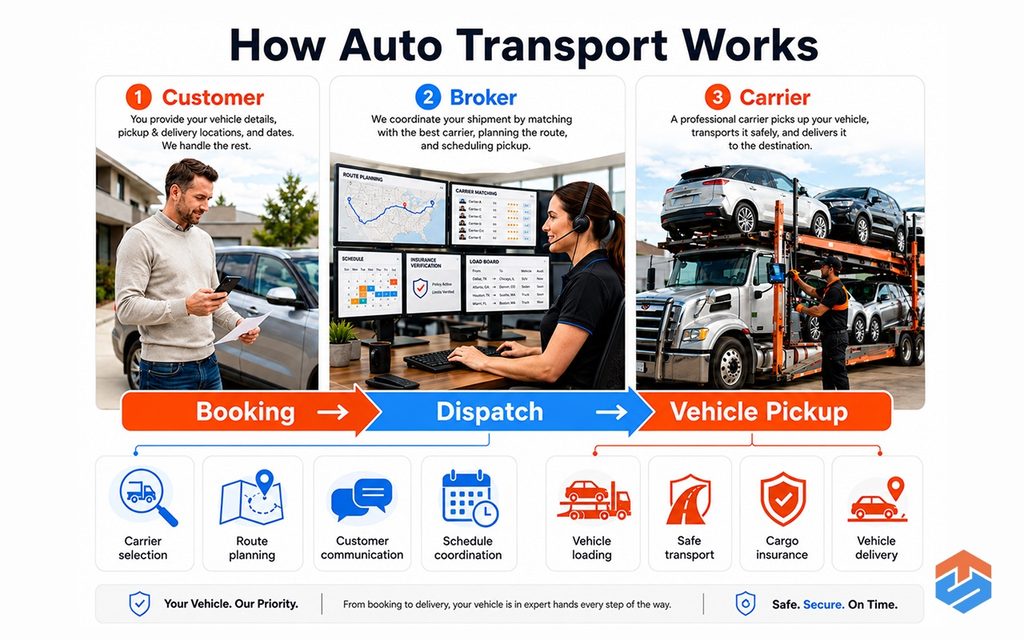
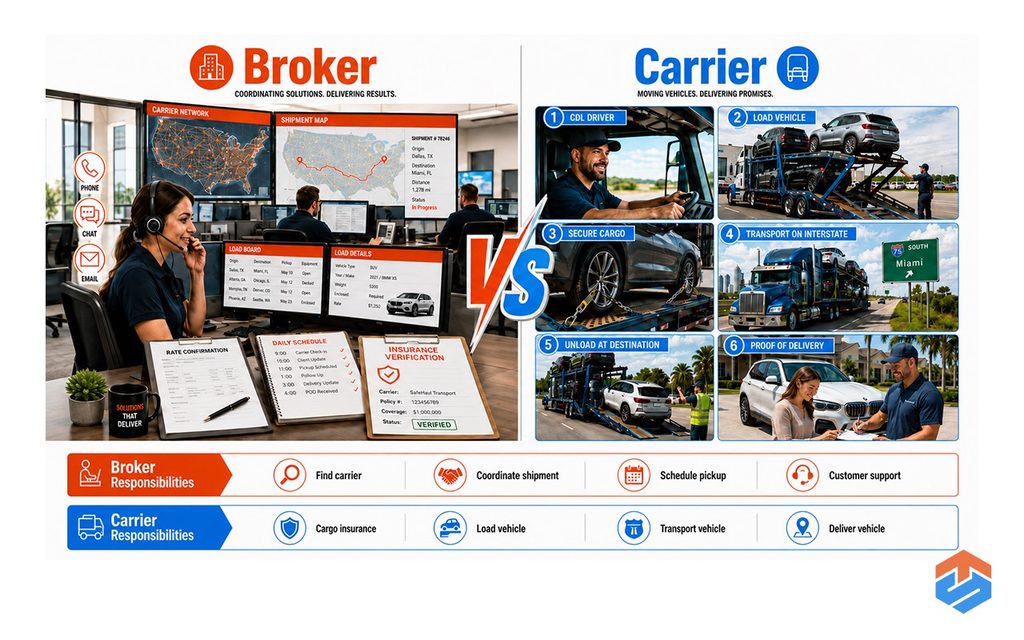
An auto transport broker is a logistics matcher. You give them your shipment – pickup, destination, vehicle, dates – and they post it to an industry load board such as Central Dispatch, then find a carrier willing to run it at the price they’ve set. That’s the mechanics of it.
The sincere one goes further. A good broker will check the carrier before they provide you with your vehicle: Has a valid insurance policy, active FMCSA authority, a clean safety record. They make arrangements with you and the driver, are your one and only point of contact throughout the move, and come in handy when things go wrong during the move. That’s the real work, and that’s why they get paid by the broker. The abbreviated version – load low, take whomever bites, get away after booking – is the reason for the bad rap for brokers. They’re both titled the same, and that’s why it’s so hard to tell from the label.
What a Carrier Actually Does
A carrier is the trucking company that owns the rigs and employs or contracts the drivers. They’re the ones who arrive at your door, load your vehicle, drive the route, and deliver it. When people picture “the auto transport company,” they’re usually picturing a carrier – even though the company they booked with often isn’t one.
The reason most companies aren’t carriers is simple: it’s expensive. A car-hauler trailer runs well into six figures, the truck to pull it costs as much again, and insurance, fuel, and keeping drivers on the road add up every month. So the carriers that do operate tend to be small to mid-size – an owner-operator with a couple of trucks, or a fleet of a few dozen – and they stay busy partly by taking loads from brokers when their own bookings don’t fill the schedule.
How the Broker-Carrier Handoff Works
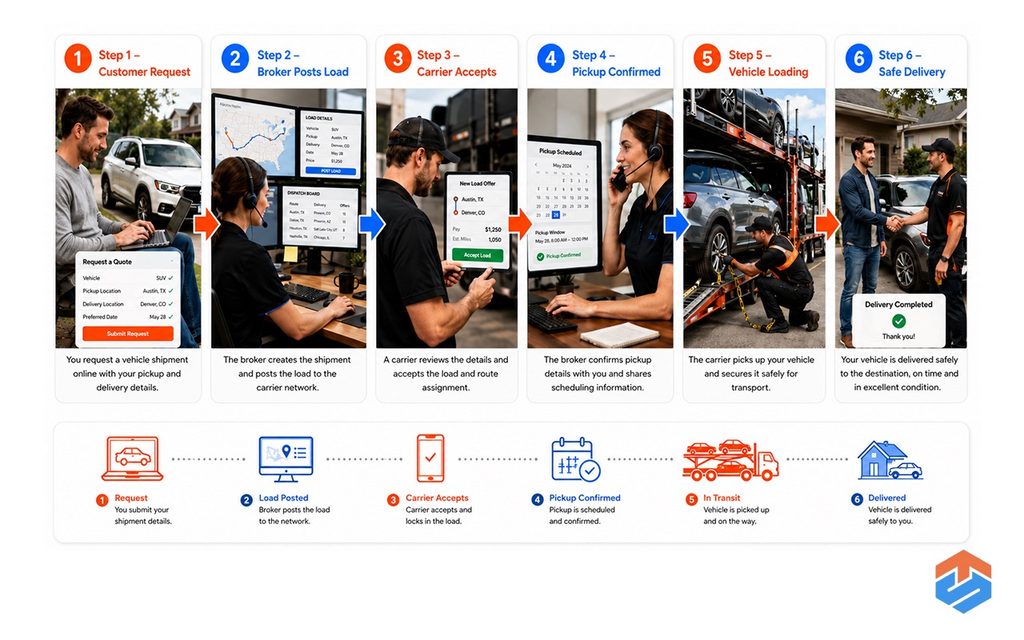
Once you book with a broker, your shipment moves through a short chain. The broker posts your load to the board at the price they’ll pay a carrier. A carrier browsing for loads that fit their route accepts it – possibly a carrier that has never heard your name. They commit to a pickup date, the broker confirms it with you, and from there pickup, transit, and delivery happen between you and the driver, with the broker relaying anything that needs to change.
The handoff is also where most problems surface. The carrier never spoke to you; they got your details from a post. If the load was underpriced, the carrier can walk and your pickup slips. If your car has a constraint the broker didn’t flag – inoperable, oversized, heavily modified – the driver can refuse it on arrival. Most shipments go fine. The ones that don’t almost always trace back to a thin or rushed handoff, which is why how a company manages that step matters more than the label it wears.

Broker vs Carrier – What Changes for You
Three things shift depending on who actually moves your car, plus one that trips up a lot of people – insurance.
| Broker | Carrier | |
| Who shows up | A carrier the broker hired | Their own truck and driver |
| Pricing | A market estimate that can shift if underpriced | Grounded in their own costs and schedule |
| Route coverage | Wide – many carriers, more date options | Limited to their own lanes and timing |
| Communication | Routed through the broker to the carrier | Direct with the truck moving your car |
| Who insures your vehicle | The assigned carrier’s cargo insurance | Their own cargo insurance |
| If something goes wrong | A good broker coordinates the fix | The carrier owns it directly |
| Deposit | Usually, once a carrier is assigned | Often none until delivery |
On insurance specifically: your vehicle is covered by the carrier’s cargo insurance while it’s on the truck – not the broker’s. Brokers don’t insure your car directly, though reputable ones carry contingent coverage and, more importantly, confirm the carrier’s policy is real before dispatch and help you file if a claim comes up. If a company can’t tell you whose insurance covers the vehicle, that’s your answer. Our guide to handling vehicle transport damage walks through how those claims actually work.
Pricing works the same way underneath. A broker’s quote is a bet on what the carrier market will accept; if the bet is low, your price rises or your pickup drifts. A carrier’s quote is grounded in its own truck, fuel, and route. Neither is dishonest – but it explains why the cheapest broker quote is often the least reliable, a pattern we cover in expensive car shipping mistakes that cost you money.
What If I Just Want to Avoid Brokers?
Many people look for a specific carrier and not a broker, and typically it’s because of a bad experience. That’s the instinct, and that’s what it means when you have a direct carrier – a company that owns the equipment, the driver, and the result, with nothing in between. When your travel dates are flexible, and your route coincides with a carrier’s regular route, it can be clean and accountable to book via the carrier.
Coverage is the problem. A single carrier carries only its own lines and operates on its own timetable. Whether you’re relocating across the country, shipping on an unusual lane, picking up someone in the countryside, or have a tight schedule, you will find that you are likely to be stuck waiting or forced to pay more – or that you are just quietly hauled off to a broker. The true giveaway of the “avoid brokers” advice is that it doesn’t mention that part. A broker that does, in fact, screen its network alleviates the same issue that the naysayers are concerned with: all the carriers have been screened, they’re accountable and known, and you have one contact that’s responsible for the move. The single thing to avoid is a company keeping its broker secret or giving your car to the cheapest broker on the board the day you are transacting with them.
How to Tell Who You’re Really Working With
You don’t need industry knowledge to sort the good from the sketchy. Three questions do most of the work, and the answers are short.
“Do you own trucks, or do you broker the load?” An honest broker says “we broker.” An honest carrier says “we own and operate.” A company that gets vague here is hiding something.
“Will I get the carrier’s name and USDOT number before pickup?” Yes is the only good answer. Anything evasive means they’d rather you didn’t verify the carrier yourself.
“If something goes wrong in transit, who’s my contact – you or the driver?” A company that owns the answer keeps you out of the middle. One that routes you to “the carrier” has already told you how a problem will go.
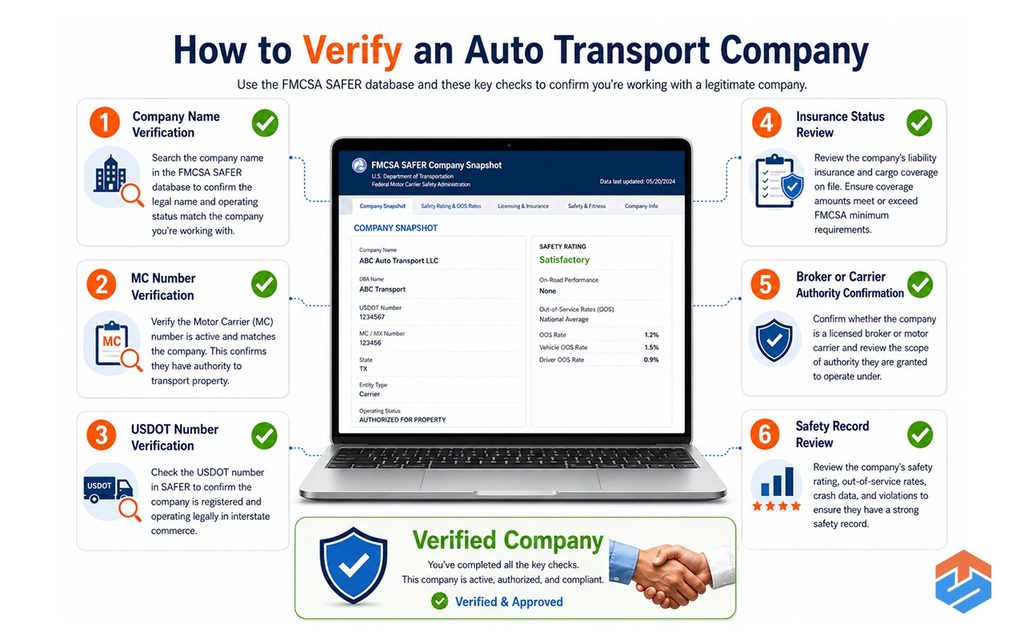
Then verify it yourself. Every legitimate broker and carrier is registered with the FMCSA SAFER database, where a search by company name or MC/USDOT number shows whether they hold broker authority, carrier authority, or both, along with their insurance status and safety record. Our walkthrough on how to check a USDOT number shows exactly where to look. Any company that won’t give you its number when asked is one to walk away from – the same rule we flag in common mistakes when shipping a vehicle.
One more practical checkpoint: the deposit. Brokers typically collect one once a carrier is assigned, which is normal. A demand for a large deposit up front, or a cancellation fee north of about 30%, is not. If the numbers feel off, our breakdown of how auto transport billing and deposits work gives you the baseline to compare against.
Where Truck Spot Fits
Truck Spot Logistics works as an auto transport broker with a vetted carrier network – and we answer the three questions above the way you’d want them answered. We tell you plainly that we broker your load, we disclose the assigned carrier’s name and USDOT number before pickup, and we stay your point of contact from booking through delivery instead of handing you off to the driver. The carriers we dispatch to are checked for active authority, valid insurance, and a clean safety record before your car ever goes on a truck.
That’s the whole point of doing it right: the flexibility and pricing of a broker, without the anonymous-load-board gamble that makes people want to avoid brokers in the first place. When you’re ready, get a free vehicle shipping quote or read up on how we calculate shipping cost so the number makes sense before you book.
FAQ About Auto Transport Brokers vs Carriers
What’s the difference between an auto transport broker and a carrier?
A broker matches your shipment to a carrier, usually through an industry load board, and coordinates the move. A carrier owns the trucks and physically drives your vehicle. Most auto transport companies are brokers because it takes far less capital; the carrier is who actually shows up at your door.
Is a broker or a carrier cheaper?
It depends on your route. A broker can shop many carriers and often finds a competitive price, especially on common lanes and flexible dates. A carrier running its own route can be cheaper on that specific lane. The cheapest broker quote, though, is often the least reliable, because it may be underpriced for the load board.
Should I use a broker or book a carrier directly?
Book a carrier directly when your route matches its regular lane, and your timing is flexible – you get one accountable company. Use a broker for cross-country moves, unusual lanes, rural pickups, or tight timelines, where a single carrier’s schedule won’t line up. A broker with a vetted network gives you that reach without the load-board gamble.
Who is responsible if my vehicle is damaged – the broker or the carrier?
The carrier is. Your vehicle is covered by the carrier’s cargo insurance while it’s in transit, not the broker’s. A reputable broker verifies that coverage before dispatch and helps you file a claim, but the carrier holds the responsibility for the car itself.
How do I check if an auto transport company is legit?
Search the company on the FMCSA SAFER database by name or MC/USDOT number. It shows whether they hold broker authority, carrier authority, or both, plus their insurance status and safety record. Any company that won’t give you its MC or USDOT number when asked is one to avoid.
Why do brokers charge a deposit?
A deposit is normal once a carrier has been assigned to your shipment – it secures the booking. What isn’t normal is a large deposit demanded up front before any carrier is lined up, or a cancellation fee over about 30% of the total. Those are red flags worth walking away from.
Will I know which carrier is moving my vehicle before pickup?
You should. A trustworthy broker discloses the assigned carrier’s company name and USDOT or MC number before pickup so you can verify them yourself. If a company won’t confirm they’ll share it, treat that as a warning sign.
Can there be a broker and a carrier for the same company?
Yes. A few carriers have both broker/carrier authority from the FMCSA and operate their own trucks on some routes, with a network of brokers on others. The benefit is that if the route is in their fleet, you don’t deal with the broker-carrier handoff at all.
Are there vehicles that are better shipped directly to a carrier?
High-value, classic, or heavily modified vehicles deserve extra care and attention, and many owners prefer to know exactly who is driving them – usually on an enclosed transport. Either way, the key is finding a vetted carrier with the right equipment and insurance. Our enclosed auto transport guide explains when the extra protection is necessary.
Is Truck Spot a broker or a carrier?
Truck Spot Logistics operates as an auto transport broker with a vetted carrier network. We tell you that plainly, disclose the assigned carrier’s name and USDOT number before pickup, verify each carrier’s authority and insurance, and stay your single point of contact from booking through delivery.