


10 MIN

Jul 21, 2026
Car Shipping in Summer – How to Book Early and Save Money (2026)
Summer is the busiest season for car shipping companies in the United States – and that single fact drives every pricing decision you need to understand before you request a quote. Between Memorial Day and Labor Day, demand for auto transport spikes sharply as families relocate between school years, snowbirds reverse their winter migrations, and college students move vehicles across states. More demand, same number of carriers, limited trailer slots. Prices follow accordingly.
The good news: the price increase is predictable, and a predictable cost is a manageable cost. Customers who understand how summer car shipping pricing works – and act on that knowledge three to four weeks in advance – consistently pay rates closer to the off-season baseline than to the peak-season ceiling. This guide covers everything you need to know to book intelligently, choose the right transport type, and avoid the most common expensive mistakes.
What You Need to Know Before We Dive In
Quick Navigation
Why Summer Is Peak Season for Car Shipping
Summer does not just feel busy in the auto transport industry – it is structurally the highest-demand window of the calendar year, and the mechanics behind that demand directly shape what you pay.
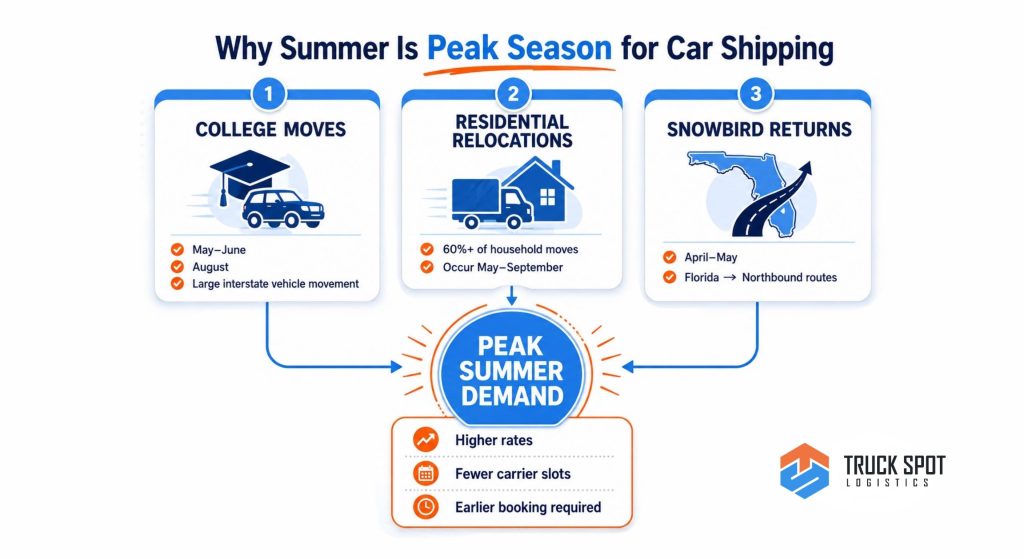
The Three Demand Drivers
College and university schedules create enormous one-directional vehicle movements every May through June and again in August. Hundreds of thousands of students’ families need vehicles moved between states, often on tight timelines tied to lease starts and orientation dates. This adds concentrated demand to specific corridors – particularly Northeast-to-South and Midwest-to-both-coasts routes.
Residential relocations cluster in summer for the simplest of reasons: people move when their children are not in school. The American Moving and Storage Association consistently reports that more than 60% of residential moves occur between May and September. A household move almost always includes a vehicle transport decision, and many of those decisions land on the same two-week windows.
Snowbird return migrations from Florida and other Sun Belt states typically peak in April, as retirees who wintered in the South begin driving or shipping vehicles back north. However, elevated movement often extends into May, creating continued northbound pressure on major corridors like I-95, I-75, and I-10 alongside early summer shipping demand.
What Peak Demand Does to Carrier Availability
Carrier capacity does not scale instantly with demand. The total number of licensed auto transport carriers in the country is relatively fixed in any given season. When 30% more vehicles need to move in the same month, the same trailers have to prioritize the loads that fill earliest and pay best. Loads posted with short pickup windows and competitive rates get picked up immediately. Loads posted at off-season rates sit on the load board while customers wait, sometimes missing their own move-in dates.
This is not a theoretical problem. If you wait until two weeks before your move date to request a car shipping quote in July, you are entering a market where the best carriers are already committed and pricing has already adjusted upward for the remaining slots.
Summer Pricing – What to Expect by Route
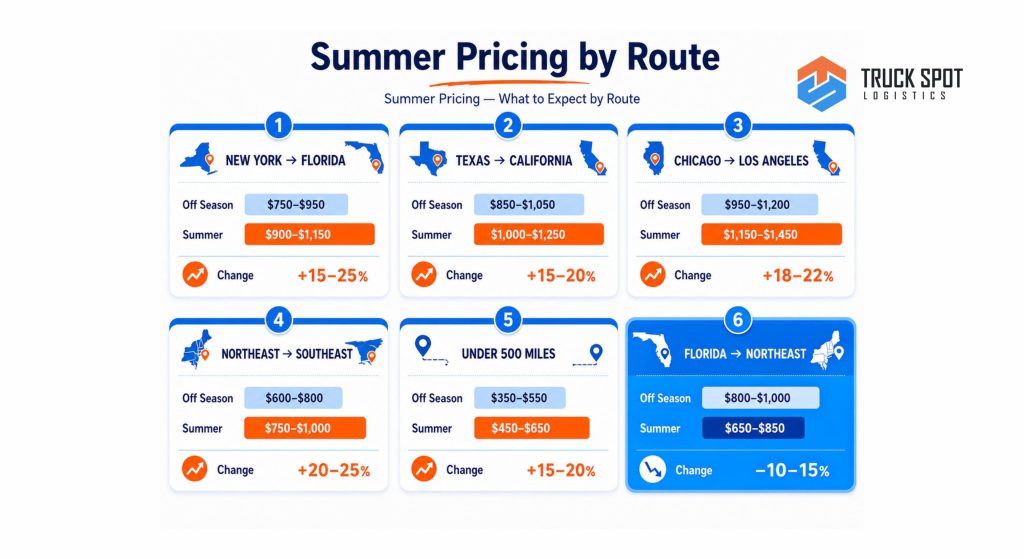
Summer pricing increases are real but vary significantly by route direction, distance, and vehicle type. The following estimates cover open transport with a standard factory-spec vehicle. Enclosed auto transport adds 30–50% on top of these figures.
| Route | Off-Season Estimate | Summer Peak Estimate | Price Change |
| New York → Florida (1,300 mi) | $750-$950 | $900-$1,150 | +15-25% |
| Texas → California (1,500 mi) | $850-$1,050 | $1,000-$1,250 | +15-20% |
| Chicago → Los Angeles (2,000 mi) | $950-$1,200 | $1,150-$1,450 | +18-22% |
| Northeast → Southeast (700–900 mi) | $600-$800 | $750-$1,000 | +20-25% |
| Regional / Under 500 mi | $350-$550 | $450-$650 | +18-29% |
| Florida → Northeast (snowbird reverse) | $800-$1,000 | $650-$850 | −10-15% (cheaper) |
Note: These are market-rate estimates for planning purposes. Actual quotes depend on exact zip codes, vehicle dimensions, pickup flexibility, and real-time carrier availability. Use our car shipping rate calculator for an accurate figure on your specific route.
The Florida Exception – Summer Is Actually Cheaper
Florida routes follow an inverted seasonal pattern compared to the national baseline. The state’s peak shipping season is October through March, when snowbirds ship vehicles south for the winter. By June, this northbound return flow has largely concluded, and demand on Florida corridors drops below the national summer spike.
The practical implication: if you need to ship to or from Miami, Tampa, Orlando, or Jacksonville in summer, you are likely looking at better rates than the October-through-March window. This makes summer the strategically optimal shipping window for Florida-bound or Florida-originating moves.
Open Car Transport vs. Enclosed Auto Transport in Summer
Transport type is the single largest lever you have on the final cost of shipping in summer. Choosing correctly means not paying for protection your vehicle does not need.
Open Car Transport – The Standard Choice
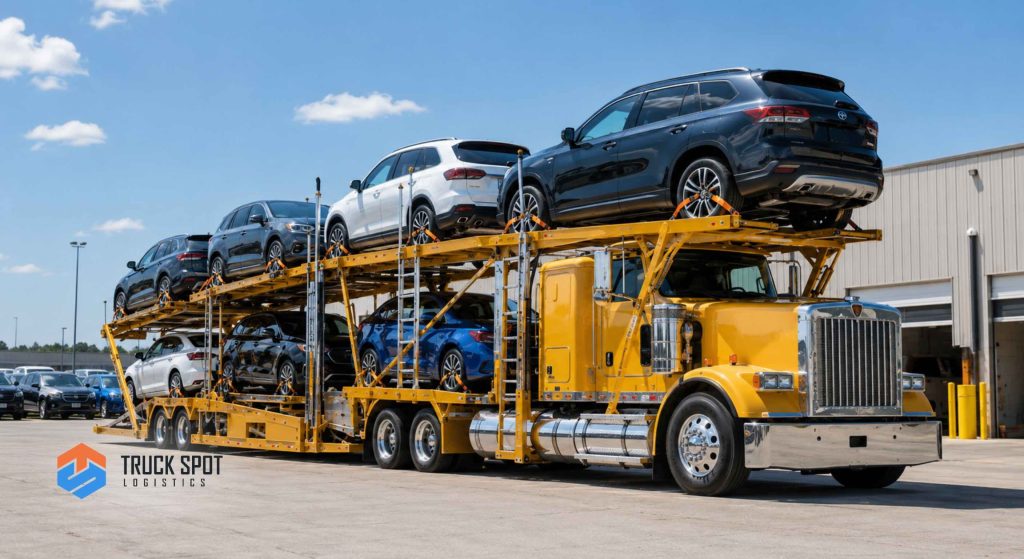
Open car transport is how the vast majority of vehicles in the United States get shipped year-round, including in summer. Your vehicle is loaded onto an open multi-car hauler – the same type of trailer you see carrying new vehicles from factories to dealerships. The vehicle is exposed to weather, sun, and minor road debris during transit.
For a daily-driven sedan, pickup truck, crossover, or standard SUV, the exposure risk is exactly the same as if you drove the vehicle yourself on the same route. Rain falls on cars. Sun hits paint. Open transport is the appropriate choice for these vehicles, and in summer specifically it remains safe, widely available, and significantly cheaper than the enclosed alternative.
Choose open car transport if your vehicle:
Enclosed Auto Transport – When the Premium Is Justified
Enclosed auto transport places your vehicle inside a fully sealed trailer with walls, a roof, and climate control options. The vehicle is protected from weather, road debris, UV exposure, and temperature swings. The cost premium is substantial – typically 30–50% over open rates – but for the right vehicles, it is a cost of doing business, not a luxury.
Choose enclosed auto transport if your vehicle:
In summer specifically, enclosed auto transport has one additional practical advantage: it eliminates the UV exposure risk on long-distance routes. On a 2,000-mile cross-country shipment taking 7–10 days in July sun, the difference in exterior condition for a luxury or classic vehicle can be material. For a standard daily driver, it is not.
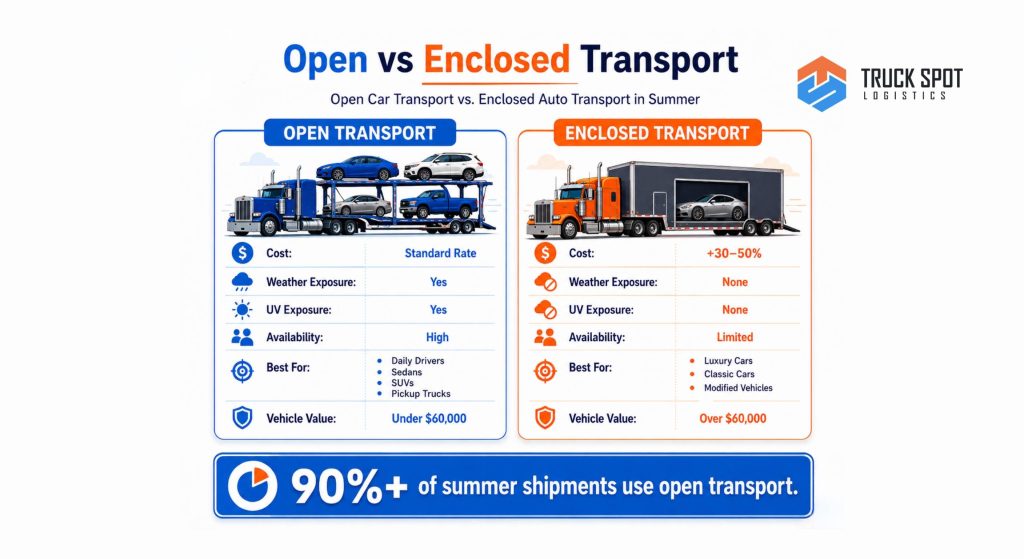
| Factor | Open Car Transport | Enclosed Auto Transport |
| Cost vs. sedan baseline | Standard rate | +30–50% |
| Weather exposure | Yes – same as driving | None |
| UV exposure | Yes | None |
| Carrier availability in summer | High | Limited – book further in advance |
| Right for daily drivers | ✓ Yes | Overkill |
| Right for luxury / classic / modified | Not recommended | ✓ Yes |
| Transit time | Same | Same |
How to Book Early and Lock In a Better Rate
The most actionable cost-reduction strategy for summer car shipping is also the simplest: book earlier than you think you need to. The auto transport market is dynamic, and carrier availability tightens faster than most customers expect during June, July, and August.
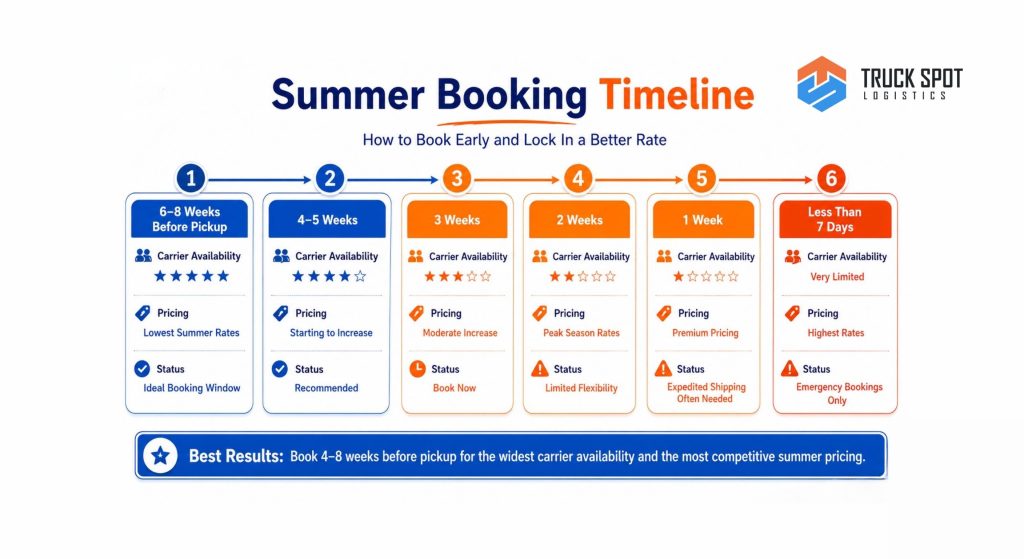
The Summer Booking Timeline
| Weeks Before Pickup | Market Condition | Recommended Action |
| 6–8 weeks out | Full carrier availability, off-peak rates | Ideal booking window – lock in now |
| 4–5 weeks out | Good availability, rates starting to move | Book this week, still competitive |
| 3 weeks out | Moderate availability, rates elevated | Book immediately, limited flexibility |
| 2 weeks out | Tight availability, peak pricing | Book now, accept higher rate or adjust dates |
| 1 week out | Very limited, premium pricing | Expedited options only, significant cost premium |
| Under 7 days | Emergency territory | Expedited car shipping required; premium unavoidable |
If your timeline is genuinely compressed, our expedited car shipping service exists specifically for this scenario – but the cost premium is real and avoidable with early planning.
What “Flexible Pickup Window” Actually Means for Your Rate
Every auto transport quote includes a pickup window – the range of dates during which a carrier can come to collect your vehicle. Customers often treat this as a formality. In summer, it is a pricing lever.
A 1-day pickup window in peak season means your broker has to find a carrier that happens to be running your exact route on that specific date. That level of specificity costs more because it eliminates most available carriers from consideration. A 3-to-5-day window lets the broker match your load to a carrier already running the route profitably, which means they can offer your load at a competitive rate and it gets accepted.
Practical rule: If your move date has any flexibility at all, give your broker a 3–5 day pickup window. It is the single cheapest adjustment you can make to your quote without changing anything else about your shipment.
Already know your dates? Get an instant quote and specify your preferred pickup window directly in the form.
Terminal vs. Door-to-Door – Does It Save Money in Summer?
Terminal-to-terminal shipping – where you drop your vehicle at a depot and pick it up at a destination depot – can theoretically reduce costs by keeping the carrier on efficient routes. In practice, during summer, the convenience difference rarely justifies the logistics burden, especially on residential moves where you are already managing multiple moving parts.
For most summer shipments, door-to-door auto transport remains the more practical default. The rate difference is rarely substantial enough to offset the added complexity of arranging your own vehicle drop-off and pickup at a terminal.
Choosing Car Shipping Companies – What Actually Matters
Summer is also the season when fly-by-night car shipping companies are most active. High demand creates cover for low-quality operators, and the combination of moving stress, tight timelines, and price sensitivity creates conditions where customers accept quotes they would normally scrutinize more carefully.
The FMCSA Verification Requirement
Before paying a deposit to any car shipping company, verify them through the FMCSA SAFER database. This is the federal government’s official registry of licensed and insured motor carriers. Any legitimate carrier or broker has a USDOT number and a valid operating authority.
You can verify a company’s USDOT number, check their insurance certificates, and confirm their operating authority is active in under two minutes. How to check a USDOT number walks through the exact steps.
Broker vs. Carrier: Understanding the Difference
Most car shipping transactions involve a broker – a company that takes your booking, posts your vehicle on the transport load board (Central Dispatch), and assigns it to a licensed carrier who actually performs the move. The broker manages the process; the carrier handles the physical transport.
This is normal and legal. The majority of reputable car shipping companies in the U.S. operate as brokers. What matters is that both the broker and the assigned carrier are FMCSA-licensed, that the carrier carries adequate cargo insurance (minimum $100,000), and that your broker communicates clearly about who will actually pick up your vehicle.
Red flags that indicate a problem:
Our car shipping service operates with full FMCSA licensing, transparent carrier assignment, and verified insurance on every shipment. We provide the carrier’s information before pickup so you know exactly who is coming and what they are driving.
What to Ask Before You Book
| Question | What a Good Answer Looks Like |
| What is your USDOT number? | Immediate, specific answer; verifiable in FMCSA SAFER |
| Who will actually pick up my vehicle? | Carrier assigned after booking, name/USDOT provided before pickup |
| What does the carrier’s insurance cover? | $100,000+ cargo coverage; damage claims go through carrier |
| What is the cancellation policy? | Clear terms, reasonable window, written confirmation |
| Is my price guaranteed after booking? | Yes, assuming vehicle matches description; changes only if vehicle details were inaccurate |
Miami and Florida Routes – The Summer Opportunity
Florida deserves its own section because the seasonal pricing pattern inverts relative to the national baseline – and most customers do not know this until after they have already paid a premium in winter.
Florida’s auto transport market is dominated by the snowbird cycle: retirees and seasonal residents who ship vehicles south between October and March, then ship them north in April and May. This creates two annual peaks on Florida corridors – the October southbound spike and the April northbound spike – neither of which coincides with the national June–August summer peak.
By June, the snowbird cycle has resolved and Florida-corridor carrier supply is relatively high relative to demand. What this means practically:
If your destination is Miami, FL 33132 or anywhere in South Florida, summer is the smart shipping window. Our open auto transport service handles Florida routes year-round, and we can provide a route-specific quote in under 60 seconds.

Preparing Your Vehicle for Summer Transport
Summer introduces specific preparation requirements beyond the standard pre-shipping checklist. Heat accelerates certain vehicle issues, and a carrier driver has the right to refuse a vehicle that is not properly prepared.
Heat-Specific Preparation
Battery and electrical: Summer heat is the leading cause of automotive battery failure. Before shipping, confirm your battery is securely mounted and has sufficient charge to start the vehicle for loading and unloading. A dead battery on an open hauler means winch service, which adds cost and delay.
Coolant and fluids: A vehicle sitting on an open trailer in July heat is not running its cooling system. Confirm your coolant level is full and your system has no known leaks before transport. Fluid leaks on an open hauler can damage other vehicles on the trailer, and you are liable for that.
Tire pressure: Heat expands air in tires. If your tires are already at the maximum recommended PSI, air pressure will increase further during transport on a hot summer day. Inflate to the lower end of the manufacturer’s recommended range before shipping.
Standard Pre-Shipping Checklist
For SUVs, lifted trucks, or vehicles with roof racks, additional preparation steps apply. See our SUV shipping guide for the full checklist specific to larger vehicles.
The Bill of Lading – Your Insurance Document
The Bill of Lading is the contract between you and the carrier. It records your vehicle’s condition at pickup and again at delivery. Any damage that occurs during transport must be documented on the Bill of Lading at delivery to be eligible for a claim.
Critical rule: Do not sign the Bill of Lading at delivery until you have physically inspected every panel of your vehicle in adequate light. If the carrier arrives after dark, you have the right to request a morning inspection before signing. Your signature on an undamaged delivery BoL waives your damage claim, regardless of what happened during transport.
Summer Car Shipping Cost Factors – Full Breakdown
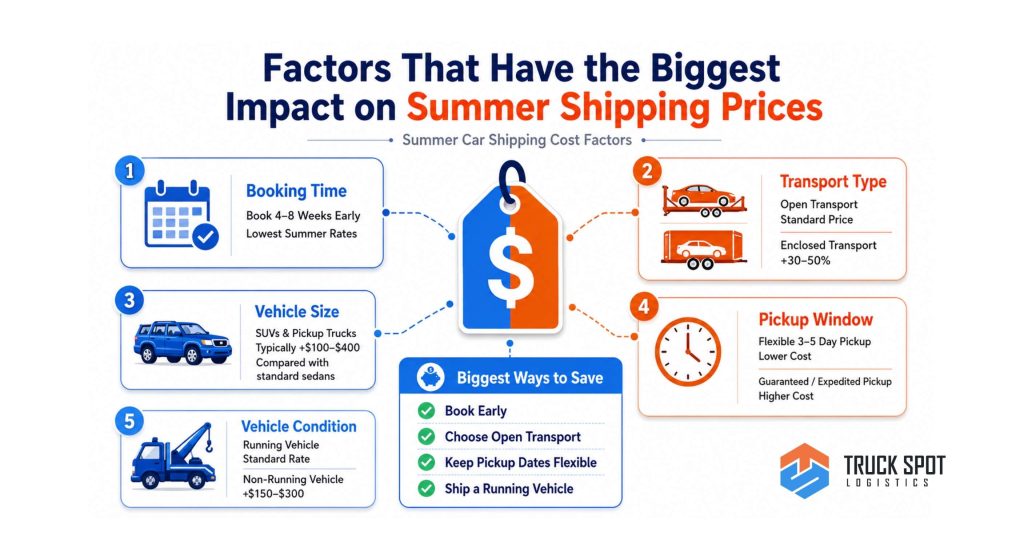
Summer car shipping rates are not a single fixed number – they are the product of several independent variables, each of which you can influence to some degree before you book. Understanding which factors carry the most weight lets you prioritize where to focus: booking timing and transport type together account for the largest share of the final quote, while route direction and vehicle specifications determine the baseline you are working from.
| Cost Factor | Impact on Summer Rate | How to Minimize |
| Booking timing | 3–4 weeks out = 15–25% cheaper than last-minute | Book as early as possible |
| Pickup window flexibility | 1-day window = premium rate; 3–5 days = standard rate | Give a 3–5 day window |
| Vehicle size/type | SUVs cost $100–$400 more than sedans | Provide exact make/model/trim |
| Transport type (open vs. enclosed) | Enclosed = +30–50% on top of all other rates | Use open unless vehicle requires enclosed |
| Route direction | High-demand corridors (NY→FL southbound in winter) command premium | Summer is better for Florida routes |
| Route distance | Price per mile decreases with distance | N/A – fixed by destination |
| Vehicle operability | Non-running vehicles require winch = +$150–$300 | Confirm vehicle starts before booking |
| Modifications / lift kit | Lifted vehicles may need specialized carrier | Disclose all modifications at quote time |
Ready to ship your vehicle this summer? The earlier you book, the more carrier options you have and the more competitive your rate.
Get your summer car shipping quote | Explore our car shipping service
The Bottom Line on Summer Car Shipping
Summer car shipping is more expensive than off-season transport – that is a structural market reality, not something any broker can eliminate. What you can eliminate is the unnecessary portion of that premium: the last-minute booking surcharge, the wrong transport type choice, the vague vehicle description that leads to a pickup-day price adjustment, and the deposit paid to a company that cannot produce a USDOT number.
The customers who pay the least in peak season are the ones who booked four to six weeks out, gave an accurate vehicle description including any modifications, chose open transport for vehicles that did not require enclosed, and gave their broker a 3-to-5-day pickup window. That combination – early booking, accurate information, appropriate transport type, flexible dates – consistently produces rates at the lower end of the summer range rather than the upper end.
For routes to or from Florida this summer, the pricing advantage runs the other direction: you are outside the snowbird peak and likely looking at better rates than October through March. Use our shipping calculator to see the current rate on your specific route, or reach out directly through our car shipping service for a quote with no deposit required upfront.
FAQ: Car Shipping in Summer
What is the cheapest time of year to ship a car?
Late fall and winter – specifically November through February – are generally the lowest-demand months for auto transport in most of the continental U.S., which translates to the most competitive rates and the widest carrier availability. The exception is Florida: winter is peak season for Florida routes, so if you are shipping to or from Florida, summer offers better pricing.
Is summer the worst time to ship a car?
It is the most expensive window for most routes, but it is not a bad time to ship if you plan correctly. The 15–25% summer premium is avoidable with 4–6 weeks of advance booking. What is genuinely avoidable is the last-minute summer rate – the 40–60% premium that applies when you are booking with a one-week window during peak season.
What is the $3,000 rule for car shipping?
This informal guideline suggests that if your vehicle’s market value is under $3,000, the cost of professional auto transport may represent a significant percentage of the car’s total worth and you should consider alternatives. The math is straightforward: if shipping costs $800 on a $2,500 vehicle, you are spending 32% of the car’s value on transport. At that point, comparing car shipping vs. towing or simply selling the vehicle locally and buying locally at the destination may be more economical.
What is the 30-60-90 rule for car transport?
This refers to carrier dispatch windows rather than a formal industry regulation. A 30-day booking placed today gives you the best carrier selection and pricing. A 60-day lead gives you essentially the same advantage. At 90 days out, you are booking so far in advance that some brokers prefer not to commit to firm pricing due to fuel and market uncertainty. The practical sweet spot for summer bookings is 4–6 weeks out.
How far in advance should I book car shipping in summer?
The ideal booking window is 4 to 6 weeks before your required pickup date. This ensures the best balance of carrier availability and competitive pricing during the peak June-August season. Booking as early as 6 to 8 weeks in advance is even better for high-demand routes, giving you maximum flexibility in scheduling and often the lowest rates. If you’re booking within 3 to 4 weeks, shipping is still readily available in most cases, but you may see fewer carrier options and slightly higher pricing, especially on popular routes. Flexibility with pickup dates helps secure better rates in this window.
Does summer heat damage a car during open transport?
Standard summer temperatures do not damage production vehicles during open transport. Modern automotive paints and materials are engineered to withstand far more severe conditions. The theoretical risk is for show-quality custom finishes or vehicles with pre-existing clear coat issues where prolonged sun exposure on a 10-day cross-country route could accelerate existing damage. For those vehicles, enclosed auto transport eliminates the variable.
Can I ship personal items inside my car during summer?
Carriers permit up to 100 pounds of personal items in the trunk, but this comes with important caveats: personal items are not covered by the carrier’s cargo insurance, they add weight that may technically conflict with FMCSA weight regulations, and visible valuables in the cabin increase the risk of opportunistic theft at rest stops. The safe approach is to ship the vehicle empty and move personal items via a licensed moving company or in your own luggage.
How long does summer car shipping take?
Transit times follow distance-based guidelines regardless of season. Regional shipments under 500 miles typically take 1–2 days. Mid-distance routes (500–1,500 miles) typically take 3–5 days. Cross-country routes (1,500–2,500+ miles) typically take 7–10 days. Summer itself does not extend transit times – there are no winter weather delays – but high carrier demand can occasionally extend the time between booking and dispatch by a day or two on heavily loaded corridors.
Is enclosed auto transport worth it in summer for a luxury car?
Yes, for the right vehicles. If you are shipping a vehicle valued over $60,000, a collector car, a show vehicle with custom paint, or a brand-new vehicle with zero miles, the enclosed premium is justified by the protection it provides against UV exposure, road debris, and the occasional summer storm. The enclosed auto transport guide covers carrier types, cost structure, and which vehicles consistently move via enclosed in the industry.
What routes are most affected by summer price increases?
Northeast-to-Southeast and Midwest-to-both-coasts corridors see the largest summer demand spikes, driven by student and family relocation patterns. Northeast-to-Florida routes are a notable exception: they are actually cheaper in summer than in the October-March snowbird season. West Coast routes tend to see moderate summer increases but nothing as dramatic as the high-demand East Coast corridors.