


5 MIN

Oct 23, 2026
How Long Does It Take to Ship a Car?
You’ve decided to ship your car instead of driving it, and now you need a date. You could start a job in another state in two weeks, your closing is set, or the semester begins on the 20th. The answer you find online is usually a range like “1 to 9 days,” which isn’t much help when you’re trying to book a flight around it.
Those ranges feel vague because car shipping runs on two separate clocks, and most guides mix them. This article separates them: how long it takes to get a carrier assigned and your car picked up, how long the drive itself takes, and how to add the two into a realistic planning window. If you already have your dates and ZIP codes, our car shipping service can give you a quote with an estimated schedule for your specific route.
What You Need to Know Before We Dive In
Quick Navigation
The Short Answer: Two Timelines, Not One
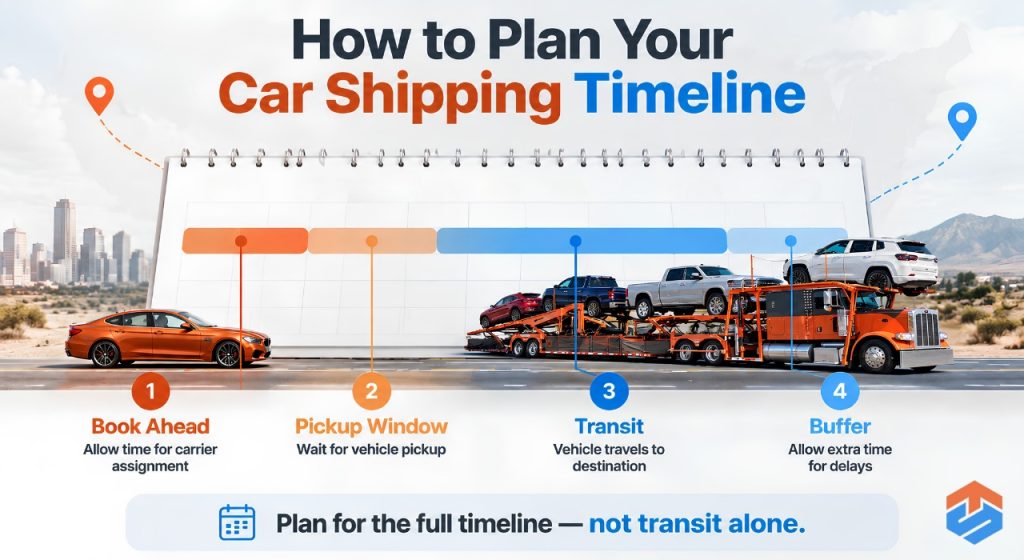
Most car shipments spend 1 to 10 days in transit, depending mostly on distance. But the full time from booking to delivery is longer because a carrier must be found and scheduled first.
Here’s the whole sequence:
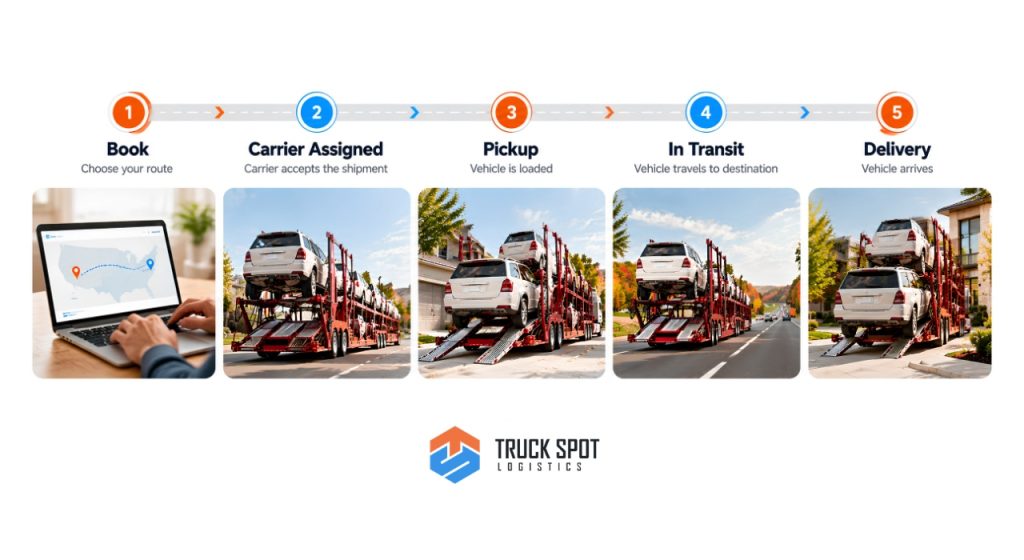
Booking → carrier assignment → pickup → transit → delivery
When a company tells you “3 to 5 days,” ask which part they mean. Some quote transit only. Others quote booking to delivery. Both can be honest and still differ by a week. Understanding which clock you’re looking at is the difference between a plan that works and a missed flight.
Pickup and carrier scheduling: usually 1 to 5 days
After you book, your shipment needs a truck heading your way with an open spot; on busy channels like Los Angeles to Dallas or the Northeast to Florida, that can happen within a day or two. On a low-traffic rural route, it can take longer. Most customers never see this stage, and it’s where surprises come from.
Transit: the drive itself
Once your car is loaded, transit follows the road. As a rough planning figure, car carriers cover somewhere around 400 to 500 miles a day. That’s less than you’d drive yourself, because a loaded truck makes multiple stops, works within federal driving limits, and takes longer routes between pickups. Treat it as a way to verify an estimate, not a fixed speed.
Total time from booking to delivery
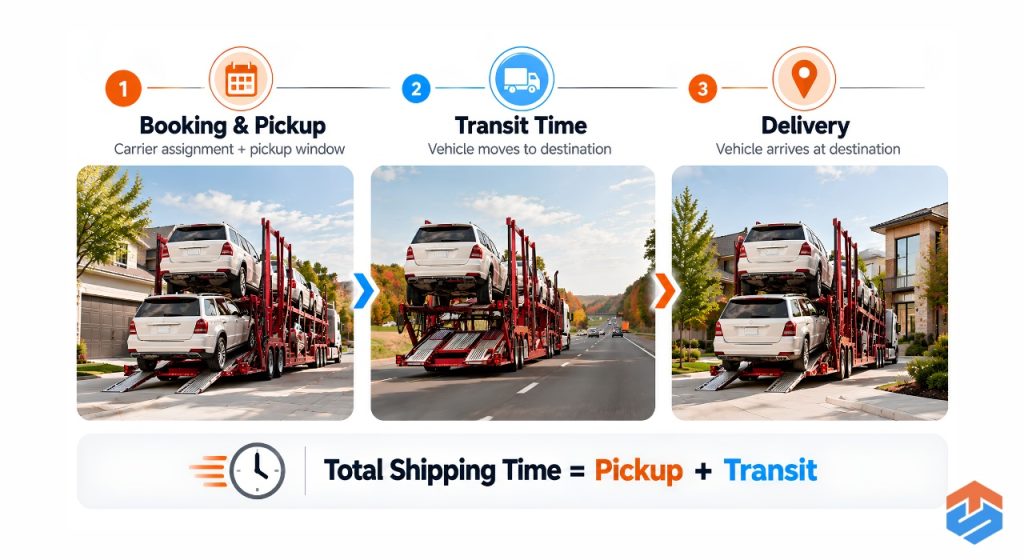
Add the two together, and always plan around the sum rather than the transit figure alone:
Total time = pickup window + transit time
Car Shipping Time by Distance
This table covers transit only, measured from the moment your car is loaded onto the truck.
| Under 500 miles | 1–3 days | Dallas → Houston |
| 500–1,000 miles | 2–4 days | Chicago → Nashville |
| 1,000–1,500 miles | 3–5 days | New York → Miami |
| 1,500–2,000 miles | 4–7 days | Houston → New York |
| 2,000–2,500 miles | 6–9 days | Seattle → Chicago |
| 2,500+ miles | 7–10 days | Los Angeles → New York |
These are typical estimates, not guaranteed delivery dates. Pickup scheduling, traffic, weather, route density, and carrier availability all change the actual timeline. For a number tied to your route, request a free quote with your two ZIP codes.
How Long Does It Take to Ship a Car Across the Country?
Coast-to-coast shipments typically take 7 to 10 days in transit, and about 10 to 14 days from booking to delivery, including carrier assignment. A truck covering 2,800 miles at 400 to 500 miles per day needs roughly a week on the road before counting stops.
East Coast to West Coast, and back
New York to Los Angeles, Boston to Seattle, and similar runs sit at the top of the range. Both directions take about the same time, though seasonal demand can make one direction easier to schedule than the other.
Midwest to either coast
Chicago, Detroit, and Minneapolis to either coast usually take 5 to 8 days. These are high-volume corridors, so carriers tend to assign them more quickly.
Southern routes
Florida to California or Texas to the Pacific Northwest generally run 6 to 9 days. Southern routes are less exposed to winter road closures than northern ones, which can make cold-weather scheduling somewhat more predictable.
How Long Does It Take to Ship a Car to Another State?
Crossing a state line doesn’t add time on its own. There’s no border check, paperwork stop, or driver change. What matters is the same thing as always: how far the car is going and how busy the route is.
A move between neighboring states is usually 1 to 3 days in transit. Two states apart is typically 2 to 4 days. Beyond that, use the distance table above rather than counting state lines, since a 900-mile move within Texas takes longer than a 200-mile hop from Philadelphia to New York. For the paperwork and preparation side of an interstate move, see our guide on shipping a car to another state.
Does Door-to-Door Shipping Take Longer?
Usually not. Door-to-door transport doesn’t add days compared with dropping your car at a terminal, and for most people it saves time overall, since you aren’t driving to and from a depot at either end.
The one situation where it can add a little time is access. If a full-size carrier can’t safely reach your street because it’s narrow, gated, or has low branches, the driver will ask to meet somewhere nearby, such as a supermarket lot. That’s a short conversation, not a delay, but it’s worth arranging in advance rather than at pickup. Our door-to-door auto transport guide covers how carriers handle access.
How Long Does Pickup Take?
When people ask how long shipping takes, they often mean this: “I booked today. When will someone actually come get my car?” It’s the least documented part of the process and the one that causes the most frustration.
The standard pickup window
Most bookings get a pickup window of 1 to 5 days, not a fixed date. The window exists because your car has to be matched to a truck already running your route. Booking 7 to 14 days before your target date gives you the best chance of the window you want.
Why pickup isn’t a fixed date
A carrier hauling 7 to 10 vehicles builds a route around all of them. If the car ahead of yours is delayed at its pickup address, everything behind it shifts. A driver can also get held up at a weigh station or hit a closed road. Carriers build slack into their schedules for exactly this reason.
City vs rural pickup
A pickup in Phoenix or Atlanta has many trucks passing through daily. A pickup in a small town two hours off the interstate has far fewer, and a carrier may need to wait until another shipment in the area makes the detour worthwhile. If your street is narrow, gated, or has a low-hanging tree line, the driver may ask to meet at a nearby lot; our door-to-door auto transport guide explains how that works.
What happens once a carrier is assigned
For who does what in this handoff, see our article on broker vs carrier; for the paperwork, see the documents you need during auto transport.
What Affects How Long It Takes to Ship a Car?
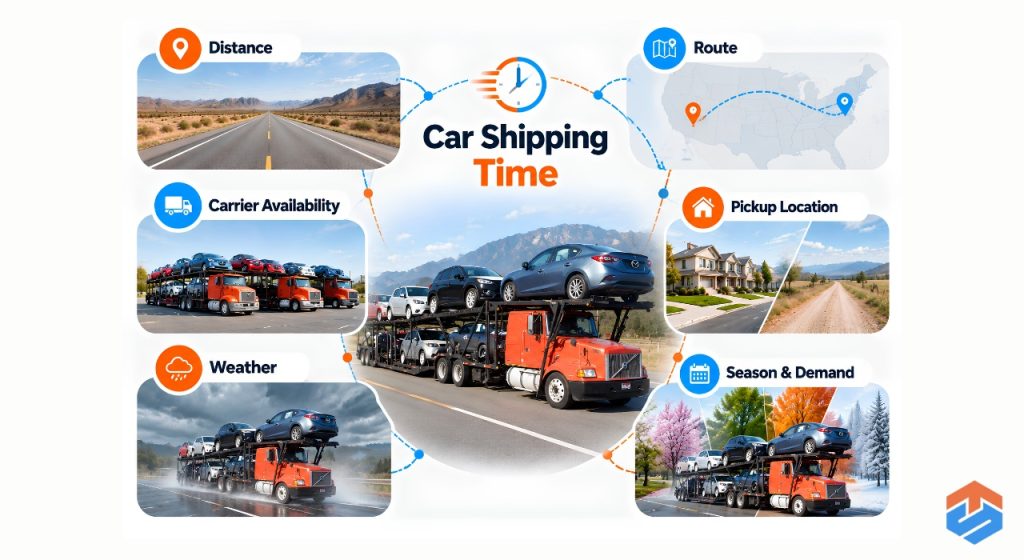
Distance and route density
Distance sets the floor, but route density decides how quickly you get moving. A 1,000-mile shipment along I-95 often beats a 600-mile shipment across rural Montana, because far more trucks run the first route.
Pickup and delivery locations
Major metro areas generally see more carrier traffic, so they tend to offer more pickup options and shorter waits. Suburbs are usually straightforward. Rural and remote addresses can add time at both ends, since the carrier has to fit a detour into an existing route.
Carrier availability
This is the factor most guides skip. Your timeline depends less on mileage than on whether a truck with an open slot is already heading your way. When carriers are scarce, everything slows down regardless of distance.
Season and demand
Summer moves, the January snowbird return, and holiday weeks all raise demand. Higher demand doesn’t make trucks drive slower, but it does make pickup scheduling less flexible and space harder to reserve. Our guides on summer car shipping and how weather affects vehicle shipping go into more detail.
Weather
Snow and ice in the Rockies and the Northeast, hurricanes along the Gulf and Atlantic coasts, flooding, high winds, and mountain pass closures can all add days. Carriers will not run unsafe roads with ten cars on the trailer.
Traffic, construction, and road closures
City traffic and construction seasons add hours that add up over a multi-day run.
Other vehicles on the truck
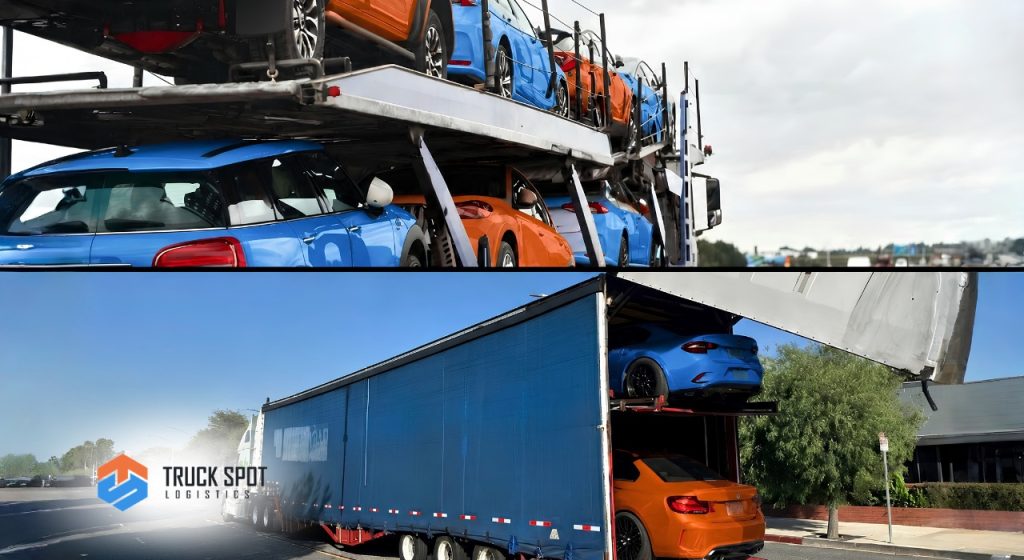
An open carrier holds 7 to 10 cars, each with its own pickup and delivery address. Your car rarely travels A to B directly. That’s also why open transport costs less per car, so the extra time is part of the trade.
Federal driving limits
Truck drivers work under FMCSA hours-of-service rules. A property-carrying driver may drive a maximum of 11 hours after 10 consecutive hours off duty, cannot drive beyond the 14th hour after coming on duty, and must take a 30-minute break after 8 cumulative hours of driving. There’s also a 60/70-hour limit across 7 or 8 days. That is why a truck can’t match the pace you’d set driving the same route yourself, and it’s a safety feature, not a delay.
Does Open or Enclosed Transport Take Longer?
Once a car is on the truck, enclosed transport doesn’t drive any slower. In fact, enclosed trailers carry fewer vehicles, typically 2 to 6, so they sometimes make fewer stops and take a more direct route.
The difference is scheduling. Far fewer carriers offer enclosed service, so it can take longer to assign a truck, especially on less common routes. In practice:
| Carriers available | Many | Fewer |
| Typical pickup window | 1–5 days | Often longer to schedule |
| Transit speed | Standard | Similar, sometimes more direct |
| Stops en route | 7–10 vehicles | 2–6 vehicles |
So the accurate way to put it: enclosed transport doesn’t add days to the drive, but it can add days before the drive starts. See our guides to open auto transport and enclosed auto transport. If you need speed on a short route, hot shot transport is another option worth knowing about.
How to Estimate Your Own Shipping Time
Use this formula rather than a single number:
Estimated total = pickup window (1–5 days) + transit time (from the table) + a small buffer
A worked example for a 1,200-mile move, say Chicago to Fort Lauderdale:
If you have a hard deadline, count backward from it using the top of the range, not the bottom. Booking 7 to 14 days out gives the schedule room to absorb a delay without costing you anything. For how these same factors affect price, see how to calculate vehicle shipping cost.
Can You Ship a Car Faster?
Yes, but it helps to know which part of the timeline you’re actually shortening.
Book earlier
More lead time gives carriers more flexibility to match your shipment to a route they’re already running. It also costs nothing.
Be flexible with dates.
A three-day window instead of one specific morning widens the pool of trucks that can take your car.
Choose open transport
More carriers, faster assignment, lower cost.
Use an accessible pickup and delivery point.
Meeting a driver at a nearby shopping center rather than a narrow residential street can shave a day off scheduling.
Consider expedited service
Expedited car shipping prioritizes your shipment for faster carrier assignment and pickup. It’s worth being clear about what it does: it speeds up getting your car on a truck. It does not make the truck drive faster than federal limits allow.
What Is the Fastest Way to Ship a Car?
In most cases, it’s expedited service on a high-volume route with open transport and accessible pickup and delivery points. Note what that actually shortens: the carrier assignment and pickup stage, not the drive. Transit speed is set by the route, road conditions, and federal driving limits, and no service tier changes those. So the realistic goal isn’t a faster truck; it’s fewer days spent waiting for one.
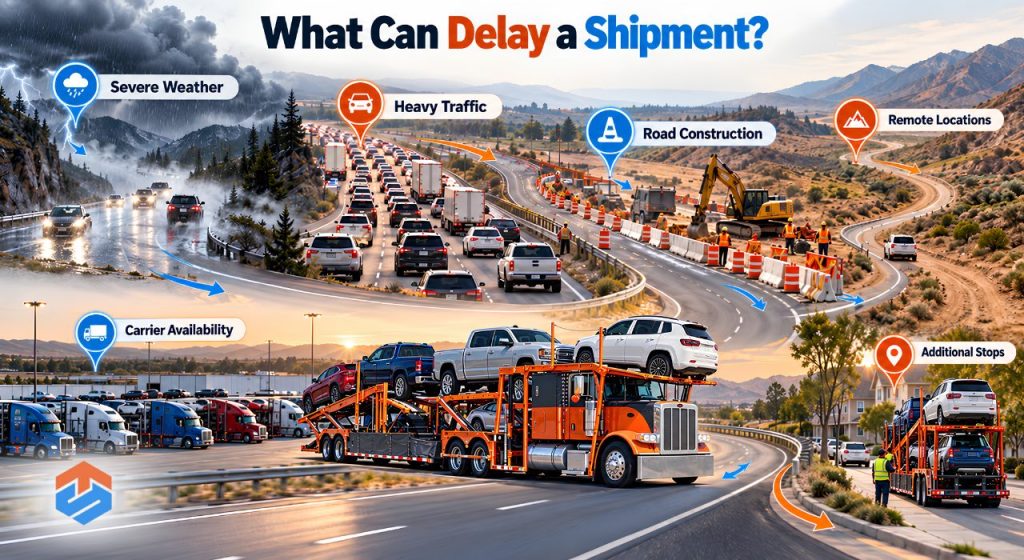
What Can Delay Car Shipping?
The last one is the only item on this list you fully control. Our guide to common mistakes when shipping a vehicle covers the rest of the preparation.
How Accurate Are Car Shipping Delivery Estimates?
Estimates get more accurate as they get closer. Before a carrier is assigned, any date is based on averages for your route. Once a specific driver has your car on a specific route, the window narrows considerably, and the driver will usually call ahead before delivery.
Unless you’ve purchased a guaranteed delivery service, treat the date as an estimated window rather than a guarantee. This is standard across the industry and reflects genuine road conditions, not evasiveness. Plan a buffer of a couple of days, especially in winter, and don’t schedule anything that can’t move if the estimated delivery date shifts. At delivery, inspect the car against the Bill of Lading before you sign; our vehicle transport damage guide explains what to do if something’s wrong.
Planning a Shipment Around a Deadline?
If you have a date you can’t move, book early and count backward using the top of the range. Enter your pickup and delivery ZIP codes and your vehicle details, and you’ll get a quote with a predicted timeline for your route in about a minute, with no upfront payment to book.
Still comparing options? Our car shipping service page covers what’s included, how we vet carriers, and what happens at pickup and delivery.
FAQs
How long does it usually take to ship a car?
Most shipments take 1 to 10 days in transit, depending on distance. Adding carrier assignment and pickup scheduling, the full time from booking to delivery is usually 1 to 2 weeks. Short regional moves can be done in a few days; coast-to-coast moves take the longest.
How long does it take to ship a car 500 miles?
About 1 to 3 days in transit once the car is loaded. Adding a typical pickup window, plan for roughly 3 to 7 days from booking to delivery.
How long does it take to ship a car 1,000 miles?
Usually 2 to 4 days in transit. With pickup scheduling, a realistic planning window is about 4 to 9 days from booking to delivery.
How long does it take to ship a car 2,000 miles?
Typically 4 to 7 days in transit, or roughly 6 to 12 days from booking to delivery once carrier assignment is included.
How long does it take to ship a car across the country?
Coast-to-coast transit generally takes 7 to 10 days, and about 10 to 14 days from booking to delivery. Car carriers average 400 to 500 miles per day and make multiple stops along the route.
How long does it take for a carrier to pick up my car?
Most pickups happen within a 1 to 5-day window after booking. Busy metro routes are often faster; rural addresses can take longer. Booking 7 to 14 days ahead improves your chances of getting the window you want.
Does enclosed car shipping take longer than open transport?
Not on the road. Enclosed trailers carry fewer cars and sometimes take a more direct route. But fewer carriers offer enclosed service, so scheduling a pickup can take longer.
What is the fastest way to ship a car?
Expedited pickup on a high-volume route with open transport and flexible pickup and delivery locations. Speed depends on how quickly a carrier is assigned, not the trailer type.
Can weather delay car shipping?
Yes. Snow, ice, hurricanes, flooding, and mountain pass closures can add days, particularly in winter and during hurricane season. Carriers will not run loaded trailers on unsafe roads.
Are car shipping delivery dates guaranteed?
Standard transport provides an estimated delivery window rather than a guaranteed date because road conditions and carrier routing can change. Some routes offer guaranteed-date service for an additional cost.


