


10 MIN

Aug 5, 2026
Shipping a Car When Moving for Work – What You Need to Know
A job relocation rarely comes with a relaxed timeline. There’s a start date, maybe a temporary apartment, a moving truck to schedule, and somewhere in the middle of all of it, a car that also needs to get from your old city to your new one. Driving it yourself sounds simple until you add up the gas, the hotel nights, the extra wear on a vehicle you’d rather not put 2,000 miles on right before starting a new job, and the days you’d rather spend unpacking than sitting behind the wheel.
Hiring an auto transport company solves that problem, but only if you understand how the process works before you book. This guide walks through the whole timeline: how far ahead to book, what open and enclosed transport actually cost, which paperwork protects you, and the mistakes that trip up relocating employees most often. If you already know where and when you’re moving, our car shipping service has an instant quote tool built for exactly this situation.
What You Need to Know Before We Dive In
Quick Navigation
Why Shipping Makes Sense for a Work Relocation
Job-driven relocation is a bigger part of American life than most people realize. According to U.S. Census Bureau migration data, roughly 40 million Americans changed residences in a recent year, and about 2.6 million of those moves were driven specifically by a new job. If you’re one of them, the drive-it-yourself option usually looks better on paper than it feels once the moving truck, the flights, and the first week of a new job all land in the same two-week window.
Driving your own car to a new city looks free, but it rarely is once you account for everything that goes into it. AAA’s 2025 Your Driving Costs study puts the average cost of driving at roughly 13 cents per mile in fuel alone – about $260 in gas on a 2,000-mile cross country moving route, before hotel nights, meals on the road, or the extra oil change your car will need afterward. Then there’s the time itself: two to four days behind the wheel that you can’t spend house-hunting, finishing paperwork with HR, or simply resting before a new job starts.
In our dispatch team’s experience, relocating employees consistently underestimate how much of their moving week the drive itself eats up – not just the hours on the road, but the day most people need afterward just to recover from it. Shipping trades that time and mileage for a flat, predictable cost. Once your vehicle is on a truck, you’re free to fly, coordinate movers, or handle the dozen other things a relocation demands. It also means your car arrives with the same mileage it had when you handed over the keys, which matters if you’re financing or leasing and trying to stay inside a mileage cap. For a closer look at how the math shakes out for your specific route, our guide on how to calculate vehicle shipping cost breaks down the per-mile pricing logic in more detail.

How Far Ahead You Actually Need to Book
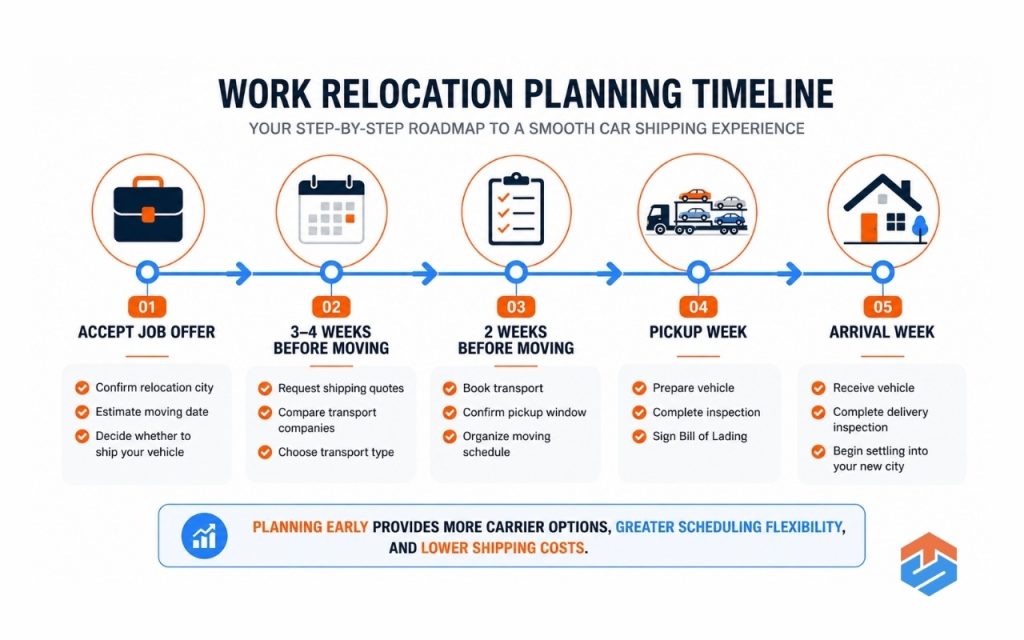
Job relocations don’t always come with generous notice, so it helps to know the realistic floor. Carriers assign vehicles to trucks that are already running your route, and most legitimate companies need somewhere between seven and ten days of lead time to make that match happen. Book with less notice than that and your load can still get filled, but you’ll usually pay a premium and your pickup window will be tighter.
If you have any flexibility at all, book earlier. The moment your offer letter or relocation notice is signed is the moment to request a quote, even if your actual move date is still weeks out. The table below shows how the market behaves as your pickup date gets closer.
One pattern we see constantly on the dispatch side: employees wait for a fully firm move date before requesting a quote, when a preliminary quote based on an estimated date costs nothing and can be adjusted later. Waiting for total certainty is usually what pushes people into the under-7-days row below.
| Lead Time | What to Expect | What to Do |
|---|---|---|
| 3–4 weeks out | Full carrier availability, most competitive rates | Ideal window – book now to lock in pricing |
| 1–2 weeks out | Good availability, rates starting to firm up | Book this week; still reasonable flexibility |
| 7–10 days out | Minimum realistic lead time for most carriers | Book immediately; expect standard rates |
| Under 7 days | Limited trucks running your exact route | Expedited shipping likely required, at a premium |
If your relocation timeline is genuinely compressed, our expedited car shipping service exists for exactly this scenario, though the cost premium is real and worth avoiding with earlier planning whenever it’s an option.
Open vs. Enclosed Transport for a Relocation
Open Carrier – The Default Choice
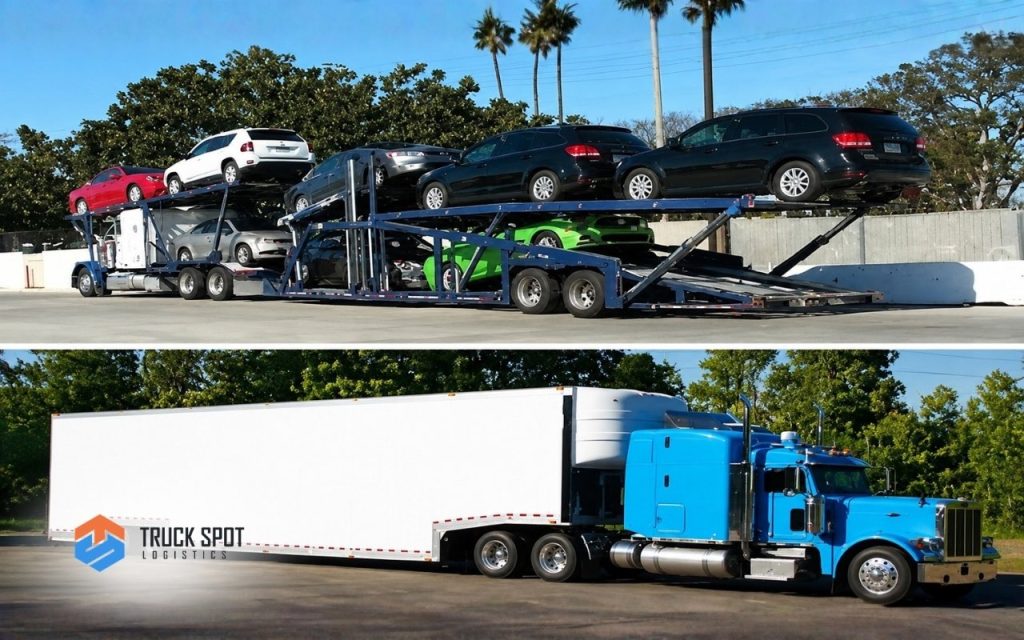
An open carrier is the standard nine- or ten-car hauler you see on the freeway. It’s cheaper, faster to book, and perfectly fine for a daily driver – new cars are shipped to dealerships this way for a reason. Our guide to open auto transport covers exactly how the loading and route-matching process works.
Enclosed Carrier – When It’s Worth the Upgrade
An enclosed carrier, by contrast, costs roughly 30–60% more but keeps your vehicle fully sealed off from road debris, weather, and prying eyes. For most work relocations involving a normal sedan, crossover, or SUV, open transport is the sensible default. Enclosed makes more sense for a low-clearance sports car, a classic, a brand-new vehicle with zero miles, or anything with a finish you’d rather not expose to a thousand miles of highway debris. Our guide to enclosed auto transport walks through the tradeoffs in more depth if you’re on the fence.
What It Costs to Ship a Car for a Move
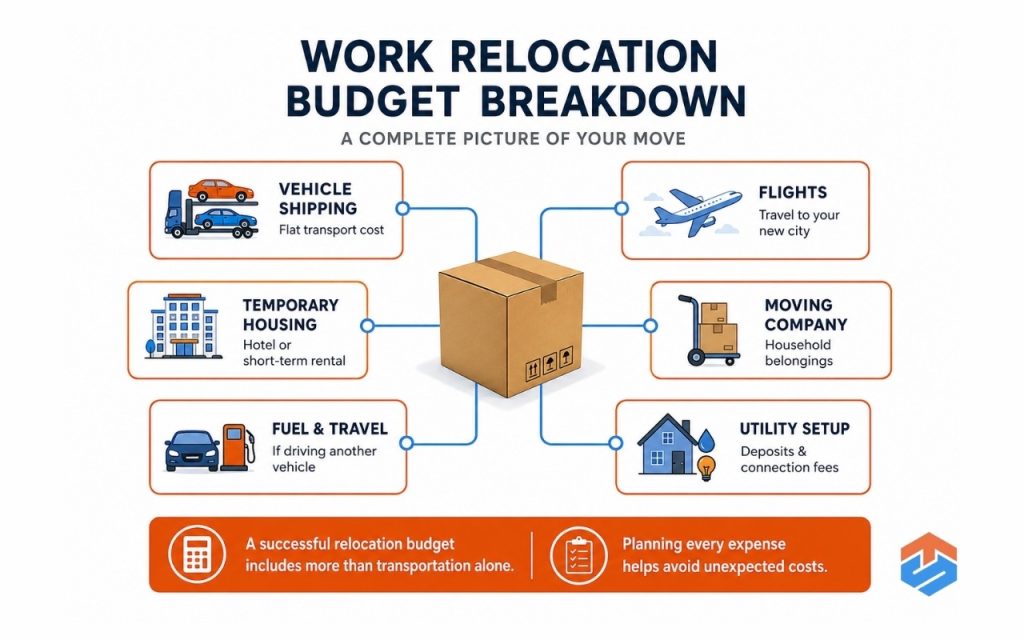
Pricing moves with three main levers: distance, vehicle size, and season. A coast-to-coast move for a midsize sedan typically lands in the $1,200–$1,600 range during normal months, while a shorter regional hop can cost as little as $600–$900. Larger vehicles like full-size SUVs and trucks run higher because they take up more space on the trailer.
| Distance | Typical Range (Open Transport) |
|---|---|
| Regional (under 500 mi) | $450–$750 |
| Mid-distance (500–1,200 mi) | $700–$1,150 |
| Cross-country (1,200–2,500 mi) | $1,100–$1,650 |
Season matters too. Summer, when families relocate between school years, tends to push prices up across most corridors. If a quote comes in dramatically lower than everything else you’ve seen, treat that as a warning sign rather than a deal – underpriced loads often sit unclaimed on the dispatch board because no driver will take them, which can leave you scrambling closer to your move date. For a full breakdown of how brokers structure their pricing and fees, see our guide to understanding auto transport billing.
Door-to-Door vs. Terminal-to-Terminal on a Deadline
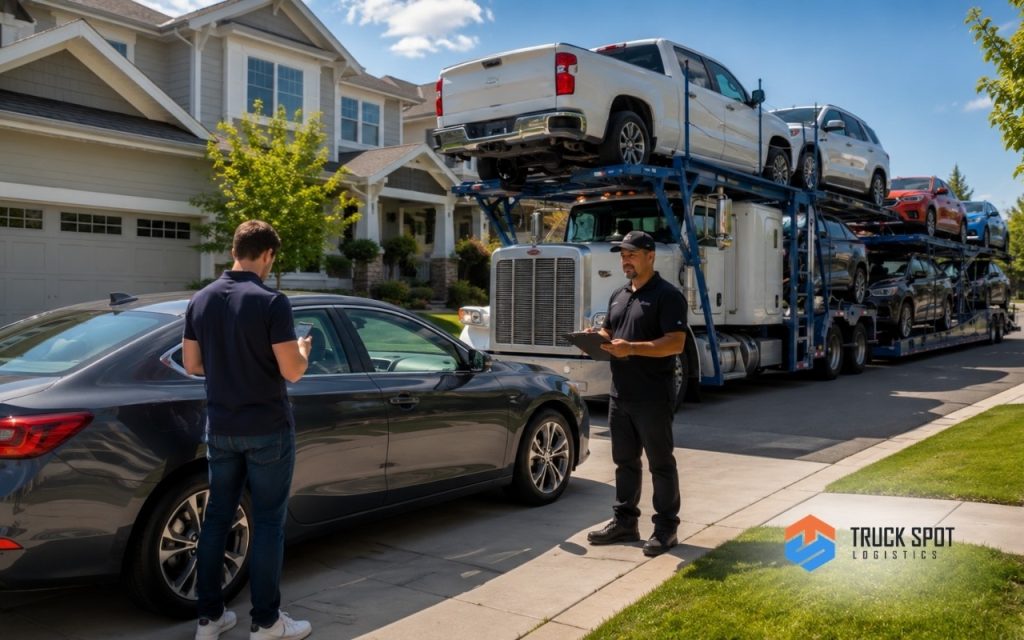
Door-to-door is what most relocating employees want and what most carriers offer by default. The driver meets you as close to your address as a 75-foot truck can safely get – usually your driveway in the suburbs, or a nearby parking lot or wide street in a dense city.
Terminal-to-terminal shipping exists and can shave a little off the price, but it rarely makes sense for a work move. You’d be coordinating drop-off and pickup at warehouses in two unfamiliar cities, on top of everything else a relocation already demands. Our guide to door-to-door auto transport covers exactly what to expect from each option if you want the full comparison.
Broker or Carrier? Understanding Who You’re Actually Hiring
A carrier owns the trucks and physically moves vehicles. A broker arranges loads with carriers across the country and doesn’t own a fleet itself. Almost every nationwide auto transport company you’ll find online is technically a broker, and that’s not a red flag – it’s actually an advantage, since brokers have access to a much larger pool of trucks than any single carrier could offer.
What matters isn’t whether a company is a broker or a carrier, but whether both the broker and the carrier they assign to your load are properly licensed and insured. A reputable broker will tell you upfront which role they’re playing and will share the assigned carrier’s information before pickup, not after.
Vetting a Company Before You Pay a Deposit
Before handing over a deposit to any company, verify them through the FMCSA SAFER database, the federal government’s official registry of licensed and insured motor carriers. Any legitimate broker or carrier will have an active USDOT number and operating authority you can check in under two minutes. Our step-by-step walkthrough on how to check a USDOT number shows exactly where to look.
It’s also worth knowing that most brokers post loads to a shared industry dispatch board called Central Dispatch, where available carriers pick up jobs that fit their route. This is standard practice across the industry, not a sign that a company is cutting corners.
The scale of the industry is part of why this vetting step matters. According to the American Trucking Associations, citing U.S. Department of Transportation data, almost 580,000 active motor carriers were registered with FMCSA as of mid-2025 – a pool large enough that quality varies widely from one company to the next. A broker’s job is to filter that pool down to carriers with a clean safety record; your job is to confirm they actually did.
Two numbers matter when you’re checking a company: the USDOT number identifies the business itself, while the MC number (short for Motor Carrier number) confirms its federal operating authority to haul vehicles for compensation. A legitimate company will give you both without hesitation.
Red Flags Worth Walking Away From
If you’d rather skip the research and compare vetted options directly, our roundup of the best car shipping companies is a useful starting point.
A Few Official Resources Worth Bookmarking
The Paperwork You’ll Need
Shipping a car for a relocation is a fairly light paperwork process compared to the rest of a move, but a few documents matter more than the others. Have your vehicle registration, proof of insurance, and a spare set of keys ready before pickup day. In rare cases, especially for financed or leased vehicles, a company may also ask for your title or a lender’s authorization letter.
The most important document by far is the Bill of Lading, a legal contract between you and the carrier that records your vehicle’s condition at pickup and again at delivery. It’s your primary evidence if you ever need to file a damage claim, so it’s worth reading closely rather than signing on autopilot. Our full rundown on the documents you need during auto transport covers every form you might be asked for, including the less common ones for financed or company-owned vehicles.
Insurance – What’s Covered and What Isn’t
Federal law requires every carrier to hold cargo insurance, but coverage limits and deductibles vary by company, so it’s worth asking for the certificate of insurance before you book rather than after something goes wrong. That insurance is meant to cover damage caused by the carrier’s negligence or equipment failure, not pre-existing wear, mechanical issues unrelated to transport, or so-called acts of God like hail or flooding.
One assumption that trips people up: your own auto insurance usually doesn’t extend to your car while it’s on a transport truck. Check with your provider before shipping if you want to confirm one way or the other, and don’t assume there’s a backup layer of coverage you haven’t asked about. For more on how carriers handle loading, securing, and liability during transport, see our piece on safety practices for loading and unloading cargo. And if you want to understand exactly how a damage claim works before you ever need to file one, our guide to vehicle transport damage walks through the process end to end.
Prepping Your Car for the Move
A little prep goes a long way toward a smooth pickup and a stronger claim if anything does go wrong in transit.
Have a spare set of keys ready for the driver, but never hand over your only set. If your vehicle isn’t currently drivable, say so when you book – inoperable vehicles need special loading equipment and usually cost a bit more to ship.
Syncing the Shipment With the Rest of Your Move
Transit time depends on distance more than anything else. Regional shipments under 500 miles typically take 1–2 days, mid-distance routes run 3–5 days, and cross-country moves take roughly 7–10 days, occasionally longer if weather or driver hours add a day. Carriers give pickup and delivery windows rather than guaranteed appointment times, so build a buffer into your plan rather than expecting the truck to arrive the exact morning you land in your new city.
| Route Type | Typical Transit Time |
|---|---|
| Regional (under 500 mi) | 1–2 days |
| Mid-distance (500–1,200 mi) | 3–5 days |
| Cross-country (1,200+ mi) | 7–10 days |
If you’re flying to your new city before your car arrives, line up a rental or rideshare for the gap rather than trying to time your arrival to match the truck’s. A four-hour delivery window can easily turn into a different morning altogether, and treating the two events as independent saves a lot of unnecessary stress on moving day.
Special Situations – Leased Cars, Reimbursement, and Military Moves
Leased and Financed Vehicles
A financed or leased vehicle can usually be shipped without issue, but it’s worth confirming your lender’s or leasing company’s policy beforehand, especially for international relocations where extra authorization is sometimes required. Our guide to shipping a leased car covers what paperwork to expect if your vehicle isn’t fully owned yet.
Employer-Sponsored Relocation and Reimbursement
Corporate relocation budgets have been trending up, not down. Atlas Van Lines’ 2026 Corporate Relocation Survey found that 61% of companies planned to increase relocation budgets in 2026, and 54% reported relocating more employees in 2025 than the year before. That’s useful context when you’re negotiating a relocation package: there’s typically more room in a corporate relocation budget than employees assume, but you still need to confirm the details with HR.
Ask early whether car shipping falls under your specific employer relocation package and whether they require a preferred vendor or pre-approved quotes before booking. Requirements vary widely by company, and getting this answer before you book saves you from paying out of pocket and waiting on a reimbursement that never quite matches what you spent.
Military Relocation (PCS Moves)
Military relocations follow their own rules, timelines, and reimbursement caps under PCS orders. Our dedicated guide to military auto transport covers how POV shipping works alongside a permanent change of station.
One financial detail worth knowing: under the One Big Beautiful Bill Act, the federal moving expense deduction is now permanently limited to active-duty military members relocating on PCS orders, plus a narrow category of intelligence community employees – civilian job relocations no longer qualify federally, regardless of how far the move is. If your move does qualify, IRS Topic 455 explains which moving costs, including vehicle shipping, can be claimed on Form 3903.
Common Mistakes That Cost Relocating Employees Money
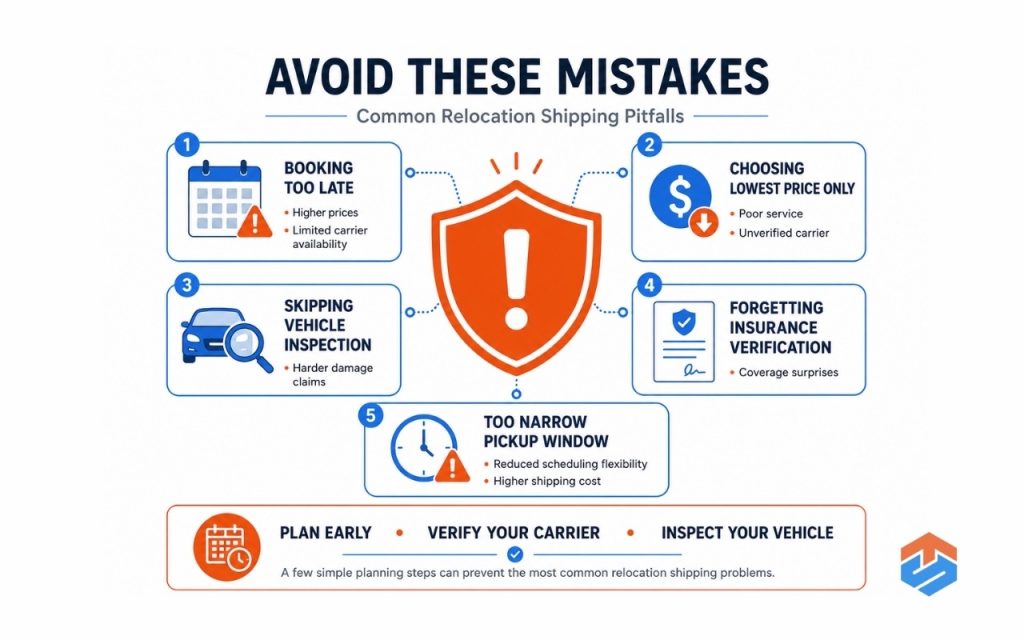
The mistakes that cost people the most during a work relocation are almost always the same handful, and nearly all of them are avoidable with a little planning. One mistake we regularly see is employees booking only three or four days before pickup, assuming auto transport works like ride-hailing. It doesn’t, and the scramble that follows almost always costs more than early planning would have.
Our deeper look at expensive car shipping mistakes and common mistakes when shipping a vehicle goes through each of these in more detail, along with a few less obvious ones that tend to surprise first-time shippers.
Delivery Day – The Inspection That Protects You
Delivery day mirrors pickup day. Inspect the car in daylight if you can, checking panels you might not have thought to look at the first time – the roof, the underside where visible, the front bumper. Compare what you see against the pickup Bill of Lading and your own photos.
If you spot new damage, note it on the Bill of Lading before the driver leaves and before you sign. Once you sign a clean delivery form and the truck pulls away, your claim becomes much harder to win, regardless of what actually happened during transport. It’s a two-minute habit that protects you far more than it costs you in time – and it’s one the drivers we work with are used to and expect, not one that slows anyone down.
The Bottom Line
Shipping your car during a work relocation isn’t complicated once you know the shape of the process: book as early as your notice period allows, choose open transport unless your vehicle genuinely needs enclosed, verify the company through FMCSA before you pay anything, and document the car’s condition at both ends of the trip. Handle those four things and the rest of the process tends to take care of itself.
Ready to see what your route costs? Get a quote through our car shipping service and we’ll walk you through the timeline that fits your start date.
FAQs Shipping a Car During a Work Relocation
How far in advance should I book car shipping for a job relocation?
Aim for at least 7–10 days before your ideal pickup date, since that’s the realistic minimum most carriers need to assign your vehicle to a truck already running your route. Three to four weeks out is better still and typically gets you the most competitive rate and the widest pickup window.
Is it cheaper to drive my car or ship it during a relocation?
It depends on the distance, but shipping is often comparable or cheaper once you add up fuel, hotel nights, meals, and the extra wear on your vehicle from a long drive. Shipping also frees up two to four days you’d otherwise spend behind the wheel instead of settling into your new city.
Will my employer reimburse car shipping costs?
Many relocation packages include vehicle shipping, but policies vary by company and some require you to use an approved vendor or submit quotes ahead of time. Check with HR before you book so you don’t end up paying out of pocket for something that would have been covered.
What happens if I can’t be there for pickup or delivery?
You can authorize a trusted friend, family member, or neighbor to meet the driver, sign the Bill of Lading, and hold a spare set of keys on your behalf. Just make sure whoever stands in for you understands the inspection process, since their signature carries the same legal weight as yours.
Can I ship a car that isn’t running?
Yes, but you need to disclose it when you book. Inoperable vehicles require winch equipment to load and unload, which usually adds a modest fee to the quote. Trying to ship a non-running vehicle without disclosing it can delay pickup or get your load turned away entirely.
How long does it take to ship a car across the country?
A true cross-country move typically takes 7–10 days once the truck is loaded, though weather and driver hours can occasionally add a day. Shorter regional routes move faster, usually within 1–5 days depending on distance.
What if my car arrives damaged?
Note the damage on the delivery Bill of Lading before the driver leaves and before you sign, then compare it against your pickup photos and paperwork. From there, you’ll file a claim through the carrier’s cargo insurance, which is why keeping thorough documentation at pickup matters so much.